Sunday, June 15, 2014

A User's Guide to Che


Back Story
~

Ernesto "Che" Guevara (June 14, 1928 - October 9, 1967), known as Che, was an Argentine Marxist revolutionary, physician, author, guerrilla leader, diplomat, and military theorist. Together with Fidel Castro, he was a major figure in the Cuban Revolution (1953 - 1959), an armed revolt against Cuban President Fulgencio Batista. Replacing the government with a revolutionary socialist state, the movement later reformed as the Communist Party in October 1965. The Communist Party, now headed by Fidel Castro's brother Raúl, governs today.

Che Melancólico Series
Rodrigo Moya 


Sometimes facial expressions are difficult to read, but other times they seem universal. In this photo, Che looks like he just took a deep breath and exhaled, letting go of some of the tension that marked these public conferences. At the same time, there is an untouched sense of wonder and trust that is palpable in his gesture. 

There are times when we wonder from where motivation arises. I can't help wondering if Che was quietly searching for that spark within himself the very moment this picture was captured. This image is not a moment of depression, this is the aftermath of excessive feelings of euphoria; excessive irritability; difficulties concentrating; disturbed sleep patterns; and insufficient nutrition. This is that moment when analysis outstripped Che's capacity for synthesis. 

Later he will probe and pull things back together, but for this one quiet moment, he was not focused on putting them back together. He was simply allowing himself "to be" ... synthesizing his impressions and thoughts in an unspoken gesture of quiet resignation that follows intensively significant states of hyper-vigilance and anxiety.

Che Melancólico Series
Rodrigo Moya 

Here Che's moment of resignation rebounds into a need to gain mastery over a self-system in chaos. The recognition of disarray and disunity can be extremely terrifying for anyone, much less to a person in his situation at the time of these highly charged socio-political events. Thus, the need to rebound intensifies, bringing with it a new level of clarity and focus. 

Whenever one disintegrates from one's surroundings, the following phase invites new ways of perceiving and increased self-awareness. In the state of true melancholy above, Che appears to have drawn himself into a state of self-analysis. In the subsequent phase of enhanced inspiration that follows melancholy, Che appears to have inspired himself with a vividness of associations. Rustling through the paperwork, the internal psychic milieu is strengthened, and higher-level association is supported.  


Che Melancólico Series
Rodrigo Moya 

The final image in the Melancholy stage is meaning, that yearning for reflection of a dynamic, and multifaceted inner world. Here, Che relights his cigar. The loneliness he suffered brought him from a stage of resignation to excitation, resting in a focused and strategic mindset. He appears pleased with himself; self-assured in his talent, knowing in his understanding of philosophy, politics, science, and human interactions. 

Che is an academic, a deeply passionate individual silenced by the wonders of nature. Devoted to the highest ideals of the causes for which he has fought, Che finds within himself inspiration. Together with the facility of synthesis, and a vividness of association to push beyond his personal struggles and emerge, Che presents to the world an individual in possession of the mental status required for grave concern over the events which have transpired, as well as the required focus it takes to devise and execute a plan. 

Che Gallardo Series
Rodrigo Moya

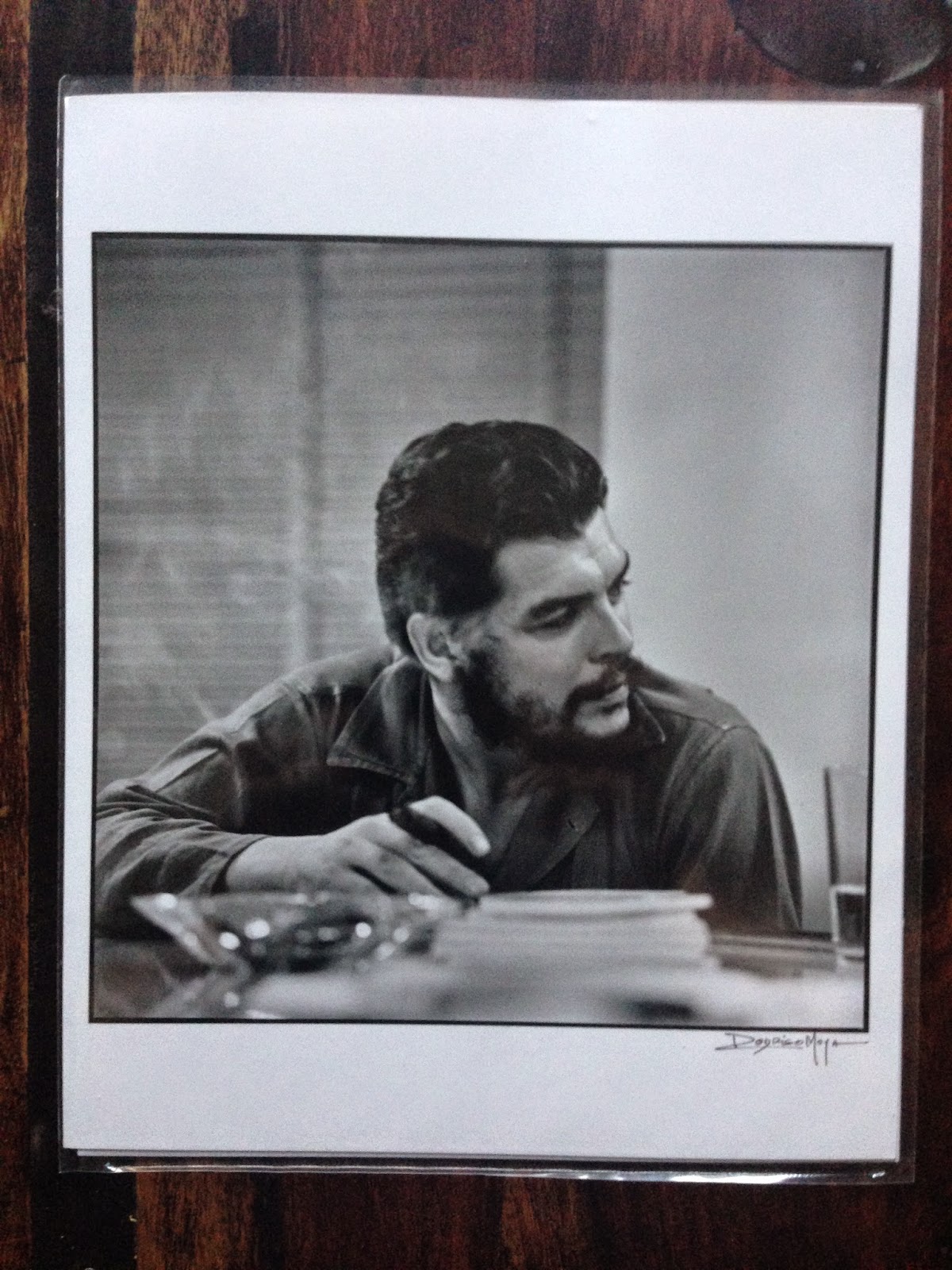
The "Gallant Che" series begins with an intellectual overexcitability. Faced with innumerable tasks and challenges, Che is sound enough of mind to recognize that his decisions and actions must be extraordinarily fluid. His ability to read and synthesize what must be done in order to co-participate in executing a well-ordered state is marked by the intense emotional expression on his face. This is a moment of extreme dissatisfaction with the unpleasantness of the tasks at hand. It is clear that he is hyper sensitive to the mood state of his environment. He must find that gentle encouragement from his cigar, which he relit prior to this image, in order to continue. 

The marked anxiety is evident - his face is taut and his upper body is tense. Here, Che must again intellectualize most of his feelings. He seems a bit unsure and disoriented when evaluating the tasks at hand. In Che's facial expressions we are capable of reading social cues and of integrating what he might have been thinking or feeling. When overwhelmed, Che does not seem overly difficult to read. His latent interpenetrating perceptions and feelings are written all over his face.
Che Gallardo Series
Rodrigo Moya

The variety of different ways Che seems to have for integrating stimuli adds complex to this collection of photographs. His sensitivity and ability to rebound hint at an "unknown field" relating to both his inner and outer worlds. His disquietude coupled with excitation, the back and forth of doctor versus revolutionary forever at play. 

In this photo the Revolutionary makes an appearance. There is a loosening of familiar processes, a new edge of creativity in one's own being, and the opportunity to forge true political change must have been heightened in his mind at this very moment. Che's counselor within attended to his grounding mechanisms by allowing for an earlier emotional discharge, but his warrior instincts put them to rest and got on with the job at hand. 

The inner equilibrium of strong feelings of unreality, disconnection from society while in the jungle, and lack of personal cohesion must have caused Che's mind to spin, for great chaos revolves around itself in the utter destruction of everything familiar. After a point, there is no more suffering, only a neutral calm of total resignation (Melancholy Che). 

Che was a thinker of exceptional quality, and all such thinkers know that they are thinkers without true knowledge. Reality lie somewhere along a stretch of interminable roads, and we are merely hitchhikers on that road; riding one piece of information until we arrive to the next.   

Che Gallardo Series
Rodrigo Moya

In the last photograph of the Gallant Che series, Che conveys to us the importance he gave to these struggles. We recognize instantly a mind at work. This is the most impressive mood change in the series. To me, it represents a softening of the emotional shell and willingness toward work and circumstances.

Within this overall complex framework, Che's ability to probe his inner world and see multiple dimensions within himself and in the environment around him were noteworthy. It is evident in these photos that Che was consistently aware of others, of physical aspects of his environment, and of the social agenda from which he was physically separated during his time in the jungle. In many ways you could call his rebounding a positive from malady - a conflict with and rejection of the prevailing political party and attitudes without losing sight of a higher moral imperative that operated within Che's mind.

Che's outlook was a driving force in much of his behavior and thoughts. His challenge of the political structure and status quo in society was excessive, but it was also the impetus behind his growing complexity of mind.


Che Jovial Series
Rodrigo Moya

In the first photograph of Cheerful Che we see him returning to a state of contemplation, initiated notably by the complexity of the decisions facing him rather than the prior emotions that had invaded his earlier thoughts. Here, Che is visually focused on resolving a challenge as he looks off in the distance. It appears as if he is simultaneously listening to the conversation of another while gathering his own thoughts. 

Che's profoundly introverted nature infused with rich imaginational, emotional, and intellectual characteristics was radically unlike those of Fidel Castro, the chief orchestrator of the overthrow of the then United States-backed military junta of Cuban president Fulgencio Batista. Castro's ultimate success in Cuba was using intelligence to maintain efficient systems. Castro became the 'father' of Cuba, providing a state for his 'family' (all Cubans, and honorary Cubans) rather than a state for just the citizens of Cuba. 

The legacy of the Cuban Revolution was in taking a long history of deep mistrust of intellectual pursuits and shifting that distrust into a firm adherence to a philosophy of pragmatism. Both Che and Fidel were extremely successful in achieving their revolutionary goals, but prone to unbalanced displays of emotion and unreasonable acts. Like Che, Fidel is complex. As Revolutionaries, both cared deeply for the rights of the unfortunate. The Revolution was a way to support their idealistic, passionate, tenacious, and complex style of operating in the world. 

Che Jovial Series
Rodrigo Moya

The vast mood improvement in this photo marks Che's inherent sense of well-being and a resurgence of hope and purpose. With profound challenges comes profound opportunities for therapeutic encounters of deep meaning and sufficient complexity that can help facilitate the transformation of cognitive functioning, emotional fatigue, and stymied processes of living in the world.

For Che, exceptional sensitivity and almost immeasurable intensity were fundamental features in the challenges he experienced. His rich inner world and his capacity for deep intellectual, emotional, and imaginational penetration into the world around him resulted in a surplus of feelings and impressions that were exacerbated by a revolutionary environment.

Understanding the thoughts that lie behind Che's facial expressions demands a great deal in terms of conceptual sophistication and sensitivity in analysis. Not being trained in psychology (other than a few courses in college), I can only rely on what my own inner thoughts tell me when I look at these images. Even for a trained psychoanalyst, anyone wishing to examine the feelings, motivations, or thoughts of another must first examine these sensitivities in him or herself. Without a meaningful exchange with the individual - which in this case is impossible - any theory we interpret is a co-creation with our own inner world.

More than anything, in this photo Che appears relieved - even if only for a moment. Maybe he sees the transformational potential in what had previously been seen as merely dysfunctional issues, which speaks to the individual growth process that follows profound surges in emotional, intellectual, and physical challenges.

Here, Che seems more authentic. His personality comes forth and we find reason to like him, considering the person behind the Revolutionary Figure.

Che Jovial Series
Rodrigo Moya

"You talkin' to me?" 

Several moral and ethical themes recur across these photographs - Che's awareness and concerns with justice, his concern for the well-being of the downtrodden; questions of right, wrong, and the relativism of these concepts; questioning death and his role in saving or ending a life; and interest in philosophy and social issues. 

As a child, Che must have been naturally very curious. We know that he read voraciously, and paid close attention to the world around him. It is almost as if he had been hyper-vigilant. Not only did he pay close attention to what other people were doing, but he was conscious of what other people's actions meant. Che must have begun processing moral and ethical issues at a very young age, which motivated his education and infamous road trip (The Motorcycle Diaries). 

Initially, upon meeting individuals like Che, others are usually touched by their sense of caring and concern, yet at the same time frequently feel concern for how and what extent to delve into these areas. Many young children act on this early awareness and sense of responsibility by volunteering at school or in their communities to make a positive contribution toward issues that concerned or inspired them. 

Che, on the other hand, adopted the humane issues of a country other than his own. Perhaps this 'outsider' attitude is what is at play in this photograph. It is that "I have a right to be here" look while simultaneously questioning that right in the person to whom he is responding. 

Irrespective of how much one comes to the aid for another, the sense of having a 'right to be there' comes up for all parties, those who offer aid as well as those who are being aided. 


Che Locuaz Series
Rodrigo Moya

While Moya titled this series Loquacious Che, I see in these last three images a stage that is characterized by integrity versus satisfaction. Rather than being satisfied with the successes of the Revolution, Che looks as if this marked the beginning of his projecting his deeply held personal views onto the world stage.

The high-powered brain that drives a person like Che does not switch into low gear simply because a milestone has been reached. For Che, who emerged as a "revolutionary statesman of world stature" (Kellner, 1989), the conflict continued. The struggle of the masses mistreated and scorned by imperialism needed help and deserved vindication.

The laws of capitalism, blind and invisible to the majority, act upon the individual without his thinking about it. He sees only the vastness of a seemingly infinite horizon before him. That is how it is painted by capitalist propagandists, who purport to draw a lesson from the example of Rockefeller - whether or not it is true - about the possibilities of success. The amount of poverty and suffering required for the emergence of a Rockefeller, and the amount of depravity that the accumulation of a fortune of such magnitude entails, are left out of the picture, and it is not always possible to make the people in general see this." 

("Socialism and Man in Cuba" A letter to Carlos Quijano, editor of Marcha, a weekly newspaper published in Montevideo, Uruguay; published as "From Algiers, for Marcha: The Cuban Revolution Today" by Che Guevara on March 12, 1965). 

Che Locuaz Series
Rodrigo Moya

While Fidel Castro settled in to run things at home, Che embarked on a series of public appearances on the international stage, delivering speeches on solidarity. He resigned from all his positions in the Cuban government and communist party, renounced his honorary Cuban citizenship, and went to fight for revolutionary causes abroad. 

It is not surprising that Che's life came to an end while fighting the good fight. Here in this photograph there is something in Che's eyes that tells the onlooker that he has not outgrown the initial revolutionary ideals he adopted. On the contrary, he is firm and steadfast in his beliefs; more so now, than perhaps in the beginning. There is an intensity in his gaze, a complexity that would elicit an equally intense reaction in anyone who looked directly into his eyes. 

It is not easy to orchestrate a Revolution, educate and train a fighting force, or establish radio broadcasts and schools from outposts in the jungle; vision, coordination, and reaction time needed in survival circumstances become heightened. 

How does a high-functioning mind respond to these heightened experiences? Not by retiring, that's for sure. It was not about substituting one ideal for another. For Che, humanism was the ideal. He must have felt that he had no other way of expressing this ideal than to continue fighting.

Che Locuaz Series
Rodrigo Moya


In this last photograph of Loquacious Che, he visibly quiet, but from the intensity of his focus, we can assume that he is talking incessantly to himself; walking himself through what will be his next course of action. The outward sign of internal intensity is sharp, but ironically his touch is light. The lighter he holds gingerly between his fingers precariously stands on end. It is not gripped, instead it is supported. It is almost a metaphor for the precarious position of his dissidents and his own role in supporting their causes.

Why did he fight for the rights of foreign citizens?

Che was anything but weak. He was handsome, highly intelligent, and beyond capable. Had he chosen to do so, he could have revolutionized Cuba into his vision of a model society. Instead, he left again to fight the good fight. Again, we ask why.

The answer to this question speaks to the intensity of individuals like Che. People who become the byproducts of a lifelong investment in mental challenges. Usually, these individuals have above-average educations, enjoy complex and stimulating lifestyles, and are married to smart ideals. This intensity is not something that is outgrown, if anything, it increases with age.

Individuals like Che continue to seek, find, and create new challenges for themselves. They work tirelessly, using their gifts and talents in meaningful ways toward their goals of making the world a better place. Many are lifelong learners and seekers of truth. Che's life was an extension of his inner experiences, his death a result of earlier phases and the repercussions associated with living a highly intense socio-political life. Associating oneself with dissenters invites dissent, which typically transcends the boundaries of dissenter and Revolutionary Hero. Che, in many ways, became a dissenter, or maybe he always was. His identification with the downtrodden spoke to an internal loneliness he must have felt in childhood. Without kindred spirits with whom to commune on the profound subjects that speak to a highly intense person, that same highly intense person begins to commune alone. Even in good company, solitary communion can leave an individual vulnerable to unhealthy mental constructs.

While Che had highly developed coping skills to combat these challenges, he pushed the limits to the point when his revolutionary actions became nothing more than a numbers game.  Eventually the game ended.

The game doesn't always have to end in tragedy. Sometimes the game can end peacefully and quietly, with few if any realizing that a game had ever been played. These individuals live in exile from their former selves and from their former lives. The intensity is still there, only it is redirected. Where it is redirected often times relates more to what the individual enjoyed before the intensities of their complex mindset evolved.

This return to self is familiar for many people; not necessarily on the same level of intensity as was the life of Che Guevara, but a level involving an extension of experiences rather than a final chapter or conclusion. It is natural to "miss" a prior mindset once circumstances no longer require its presence, but a highly intense individual in possession of a healthy mindset will inherently find a way to redirect that longing into a longing for the new activities he or she adopts.


Saturday, June 14, 2014

Positive Thought Experiments II


In Positive Thought Experiments, I shared my belief in the positive effects of thinking positively.

I take responsibility for what I am thinking and for what thoughts I allow into my mind. I focus on positive literature and humor and believe that a few silly lines and cartoons have more transformational power than the analysis of split second flash negativity. 

When I encounter a negative thought, it's this focused awareness on the positive that allows me to repel it. I don't focus on what I am not or what I cannot do. Instead, I am a humor archaeologist uncovering positivity wherever I can find it. 

Positive thought experiments wipe the slate clean of negativity in your environment. And while negativity still can arise, this positive magic wand when waved over any thought can help you sort out what is important so you can focus on what really matters. 


Since we can have only one thought at a time, 
I strive to make it a good one. 


THE PSYCHOLOGY OF PREDICTION

Interestingly enough, in the psychology of prediction, people's predictions tend to be optimistically biased (So, I'm not the only one out here inclining toward positive outcomes.). In general, people assign "higher probabilities to their attainment of desirable outcomes than either objective criteria or logical analysis warrants" (David A. Armor and Shelly E. Taylor, When Predictions Fail: The Dilemma of Unrealistic Optimism). "Yet the very prevalence of optimistic biases presents an intriguing dilemma: Given that many of the decisions people make, most of their choices, and virtually all plans are based on expectations about the future, it would seem imperative that people's predictions and expectations be free from bias." If the majority of predictions, expectations and performance-relevant perceptions are optimistically biased, how can people make appropriate decisions, or choose effective courses of action?" 

Well, let's see, shall we? 

Just because an individual is prone to optimistic biases, does not mean that they do not later sit down to evaluate those judgments. 

Take the proverbial To-Do List: 


One of the things I like about this list is that is organizes goals and activities in relation to maintaining a healthy balance. The list already sets one up for personal success (staying hydrated, rewarding the body with physical movement, responding to people who wish to hear from us, de-cluttering our environment to minimize tension). Why have a To-Do list that doesn't remind us of the things we'd like to accomplish and do for ourselves while keeping track of our responsibilities? 

In my mind, this is an example of a Positive To-Do List, a helpful reminder that keeps us on track toward achieving our happiest outcomes. A positive perspective combined with a Positive To-Do List (or Attainment Sheet) increases the probability that we will attain that which we desire. 

Liberating Imagination (2014)
Soph Laugh
Watercolor


Goals Begins With Dreams

In order to achieve our goals, we must first dream or imagine what it is we wish to accomplish. Once we have imagined what we would like to achieve, the second step is to write down or somehow articulate that goal. If, after we have written down our goal, we can imagine ourself receiving it, then this is when we begin strategizing. 

Strategy is that part of the attainment process whereby we think about all the things we might need to do or things we might need to possess in order to position ourself in front of our goal. Opportunities arise the more we do something. 

For example, I wanted to write a book, but I did not have time with my career and lifestyle to sit down and give my full-attention to the enterprise. So, instead, I began a blog. Doing so has helped me improve my writing skills, given me a perspective as to what others enjoy reading, and also built an audience. The result - improved writing skills, a clear direction, and an audience - translates into a higher probability that a publisher will someday consider a book proposal than had I waited until the timing was right for me to write a book. Once the timing is right for me, I have positioned myself to take advantage of opportunities that would not have existed otherwise. 


This scenario is the same for an athlete. An athlete practices every day, for years; reads about their sport, adjusts their lifestyle to accommodate their sport, and eventually tries out for a team or enters a competition. Whether or not they win or make it to the Olympics, for example, is a culmination of preparedness, desire, talent, and perhaps a little luck. 

For the athlete (blogger, writer, artist, mathematician, scientist, etc.) who positions themselves "on the front line of their dreams", no doubt there was first a foundation of dreaming that filtered into their imagination, that flooded their daily thoughts, that made their way onto their To-Do List, that got done, that positioned them closer to opportunities, that opened doors that they so deeply desired to enter.

Even if the results of our efforts do not look entirely like how we first imagined or dreamed them to be, the likelihood is that we are now somewhere in the mix, actively participating in the activities that make us happy, that fill our thoughts and dreams with new thoughts and dreams. This, from my perspective, is living the life, as they say. It is doing the things that make us happiest. It is turning positive biases into happy outcomes. 


Dreams Change

Sometimes we dream one dream only to discover a bigger one. Take for example my above-mentioned blogging-in-order-to-someday-write-a-book dream. Three years into blogging and I have discovered that I actually enjoy blogging for the sake of blogging. I simply enjoy writing. It is relaxing. It helps me organize my random or stray thoughts. Blogging gives me something fun or interesting to sit down and think about without the pressures associated with editing, formatting, and publisher hunting and negotiations, and it will someday make a wonderful gift to leave to my children. And the best part... I did not have to publish a book to become a writer. 

Dream achieved. 


New Dreams

I am a highly visual person. The amount of pictures that accompany my writing reflects this fact. For reasons I have shared previously, I began drawing about two years ago. Having drawn extensively as a child, art was a familiar and welcomed activity. Given that art preservation transitioned from an interest, to an aspect of my career, to a passion; creating my own art has resulted a very satisfying and highly personal link to that which captivates my thoughts.

Walking down the streets of Paris with my children I remarked how much I would love to have my own gallery. Given that we were surrounded by galleries, I said this so many times that I said to myself, "It's time to do something about this." 


I sat down and wrote out a strategic plan in order to achieve my goal. Then, some things in our lives changed and we returned to the Americas. Given that we will be in the Americas for a few years to accomplish long-term goals we had previously established for ourselves, I started wondering exactly when it would be that I would be able to open my own gallery. I was starting to think it might be years before it would happen. 

Then as I walked through my home I realized how many paintings already adorned the walls. The east corridor where we first began hanging paintings turned into two corridors of paintings, which migrated up the staircase, which made their way into the service rooms, which began seeping into the main rooms, which now adorn the hearth, a few of which are stacked in the butler's pantry, others are hung in the kitchen nook, still others cover nearly every available square inch of my library, more hang in hallways, some hang in bathrooms, others hang in the bedrooms, and so on. 

I realized that I already have a gallery. I turned my home into a gallery. With mural projects in the making, I realized that I have turned my entire home into a giant canvas. 


My dream of having my own gallery morphed into transforming my home into a personal gallery. My dream of becoming a published writer resulted in my publishing my writing in a blog. Okay, slightly different than I imagined, but a great "in the making" story. 

This story has three revelations: 

  1. Whether or not we get paid for our efforts is entirely a matter of industry.
  2. The outcomes of our dreams are not limited to the initial dreams we imagine achieving. 
  3. Dreams are the little things we do each day toward achieving our goals. 


Whatever it is you dream for yourself, I highly recommend experimenting with positive thinking processes. If acting, singing, publishing, becoming famous or outrageously wealthy is your main dream, then the likelihood is you will achieve a percentage (if not all) of that which you seek. Until we begin actively working towards our dreams will we meet them. 

A philosopher might say:

"Meeting our dreams is one of the ways in which we discover ourselves." 

For me, this creative enterprise began with a promise to discover myself. Three years later, I am discovering more than I imagined. 

Fortunately, for all of us, our dreams are not limited to what we imagine today ~ instead, they are a flourishing of who we become along the way. 


Friday, June 13, 2014

Alice in Wonderland Artwork

Alice Playing Cards (2014)
Soph Laugh
Copic Marker on Smooth Bristol Paper
11 x 17 (27.9 x 43.2 cm)

Alice's Adventures in Wonderland (1865), a novel written by Charles Lutwidge Dodgson under the pseudonym Lewis Carroll, tells of a girl named Alice who falls down a rabbit hole into a fantastical world populated by peculiar, anthropomorphic creatures such as The White Rabbit (with a pocket watch), The Cheshire Cat, The March Hare, The Hatter, The Dormouse, The Queen of Hearts, The Gryphon, and The Mock Turtle. 

Those who have read Carroll's delightful logic stories, have probably questioned their own rational thinking, their own ability to believe in the unbelievable. 

From the time of Descartes, when he, at twenty-eight-years-old uttered the word "Doubt!" a word that would reverberate for the next four centuries, the gauntlet for using reason rather than faith was set into motion, and Carroll picked it up.  In fact, Carroll mentions that Alice often gave herself good advice but seldom followed it. If you are a reader of the Latin poets, you might recall Ovid said, "I see what is best. I do what is worse."  

Throughout history people have had in common the tendency to believe too much and doubt too little. Charles Sanders Peirce (1839 - 1914), who spent the last twenty-six years of his life in seclusion thinking, thought that the warrants for belief were the inferential links that people use to hold on to or to justify their conviction and confidence in something. According to Pierce the usual warrants are: tenacious, authority, a priori, and verification. 

The Queen of Hearts - tenacious

The Queen of Hearts represents that tenacious mode, the idea or belief that one holds onto irregardless of how the situation changes or evolves. 

The Red Queen shook her head, "You may call it 'nonsense' if you like," she said, "but I've heard nonsense, compared with which that would be as sensible as a dictionary!" 

"Off with her head!" [she said] about once in a minute.

"No, no!" said the Queen. "Sentence first - verdict afterwards."

The King of Hearts - authority

The King of Hearts represents the authority mode, that mode in which people will obey authority no matter what, which can pose significant problems when the authority is wrong. In real life, blind obedience to authority leads to disaster. 

"You are all pardoned." 

"Herald, read the accusation!" said the King. 

"I'll fetch the executioner myself," said the King eagerly, and he hurried off.

['The judge, by the way, was the King; and, as he wore his crown over the wig, he did not look at all comfortable, and it was certainly not becoming.]

Alice - a priori

Throughout Carroll's stories, Alice relies on a number of a priori judgments. A priori is based on the application of a general and previously accepted principle to a particular situation. A priori judgments constitute a starting ground, but they do not always prove true in new situations. 

Alice sighed wearily. "I think you might do something better with the time," she said, "than waste it in asking riddles that have no answers." 

"If you knew Time as well as I do," said the Hatter, "you wouldn't talk about wasting it. It's him." 

"I don't know what you mean," said Alice.

"Of course you don't!" the Hatter said, tossing his head contemptuously. "I dare say you never even spoke to Time!" 

"Perhaps not," Alice cautiously replied; "but I know I have to beat time when I learn music." 

Alice - Verification

Alice exhibits verification when she insists on evidence that she herself can verify. Verification is that mode in which all evidence is examined, ideas are tested against reality. One of the ways Alice demonstrates this mode is when she examines the jar of marmalade.

She took down a jar from one of the shelves as she passed: it was labeled "ORANGE MARMALADE" but to her great disappointment it was empty. 


Alice Selfie (2014)
Soph Laugh
Copic Marker on Vellum
14 x 17 (35.6 x 43.2 cm)


Reality can sometimes be difficult to confront and verification can often times disappoint, but in the long run, and as it turns out with Alice, we are better off knowing what is real (the truth) rather than what is not real (the illusion). Sometimes verifying rather than trusting can help us out of an uncomfortable situation.

"Hold your tongue!" said the Queen, turning purple.

"I won't!" said Alice.

"Off with her head!" the Queen shouted at the top of her voice. Nobody moved.

"Who cares for you?" said Alice (she had grown to her full size by this time.). "You're nothing but a pack of cards!" 

Other times verifying can leave us empty. 

She took down a jar from one of the shelves as she passed: it was labeled "ORANGE MARMALADE" but to her great disappointment it was empty: she did not like to drop the jar, for fear of [hurting] somebody underneath, so managed to put it into one of the cupboards as she fell past it.

Of course, emptiness can lead to a revelation.

"Well!" thought Alice to herself, "after such a fall as this, I shall think nothing of tumbling down-stairs! How brave they'll think me at home! Why, I wouldn't say anything about it, even if I fell off the top of the house!" (Which was very likely true.)

Alice's revelations throughout her adventure in Wonderland raises important questions like "Is the nothing in that jar something or is it nothing? Is nothing something or is nothing nothing?"*

In other words:


Where does the candle flame go when we blow it out?


 *Bernard M. Patten, Alice: Clear Thinking in Wonderland

Thursday, June 12, 2014

26 Dimensions of the English Language


In string theory, all matter is envisioned as tiny vibrating strings, orders of magnitude smaller than the teeniest tiniest particle we can observe today. These strings are so tiny that scientists who work on the theory haven't yet found a way to experimentally observe a string, only consequences of the strings interacting. 


In quantum mechanics, the forces - electromagnetics, the strong nuclear force, and the weak nuclear force - work only because of bosons, special types of particles that bounce around and make them work. These bosons are also created by vibrating strings, so all matter and its various interactions are described as being different types of vibrating strings. 

This realization led to a prediction that caused a number of scientists to abandon the theory all together. String theory ONLY WORKS if you set up equations so that the universe has a total of 26 dimensions.

BIG BANG THEORY
"Pilot" episode

Leonard:  At least I didn't have to invent 26 dimensions just to make the math come out.

Sheldon: I didn't have to invent them. They're there.

Leonard:  In what universe? 

Sheldon:  In all of them. That's the point. 


The equations of string theory necessitate twenty-six dimensions. Beyond our known space-time dimensions: up/down, left/right, front/back, and a dimension representing our movement through time, what properties would these other dimensions represent? 

Let's take a look at the English alphabet with its 26 letters for a possible answer.


Used with units of measure, the letter "A" represents each string as a unit of measurement. 


As with plan B, "B" represents an alternative string. 


The third fixed constant or known constant represents the constant of a given string. 


The diameter of a string.


The transfer or information exchange between strings. 


The frequency of a string.


The unit of gravity equal to the force exerted on it by a given string.


The fundamental constant of a string. 


An imaginary string. 


The force of one string when it moves position. 


The base temperature of a string.


The length of a string.


The mass of a string.

An unspecified string.


Used when strings combine forms.


The probability that a string will exist.


Denoting the hypothetical source of strings.


That which gives position or direction to a string.


The distance between strings.


A hypothetical entity with a mass 360,000 times that of a string.


Denoting the change of a string.


Opposing strings.


Corresponding to a one unit difference between strings.


Denoting the principal or horizontal axis in a system of strings.


Denoting the action or result of a string.


Used in repeated form to represent the sound of buzzing strings
zzzzzz, zzzzzz


This brings us to the heart of string theory, and all of theoretical science: how much trust should be put in the equations, absent experimental confirmation? Based on the 26 Dimensions of the English language, there is no real reason to put faith in any theory, especially if it requires a boson to work.


This post was created to explain that string theory must have a system: gravity, alphabet, or otherwise, to make it work. That doesn't make string theory wrong, it just makes it really complex and super hypothetical. But it is fun to think about ...