
Friday, June 1, 2012
Statusivism
statusivism: The ethical philosophy that Facebook status updates are neither true nor false, but merely express our approval or disapproval of an action or of an individual who performs a particular action or set of actions. In this philosophy, the statement, "Be yourself," simply means, "Who you're being at the present moment is not my cup of tea, please try again."


Facebook Logic
Facebook logic: Reasoning from a set of premises to a conclusion that can be logically inferred from someone's status update. The most basic form of Facebook logic is the "like," e.g., "I like your post."


Facebook Koan
Facebook Koan: In Facebook Zenology, a riddle designed to shock us into sudden enlightenment. "What is the sound of one hand clapping?" seems to do the trick.


Ordinary Facebook Philosophy

Ordinary Facebook philosophy: A philosophical movement that seeks to understand Facebook Status Updates by examining ordinary linguistic usage. According to Facebook philosophers of this school, many questions that have befuddled deep thinkers for millennia are only befuddling because of the ambiguities and logical mistakes inherent in the "like" button. This marked the end of the Age of Befuddlement.
Faceadox

Faceadox: A piece of reasoning using apparently sound logic and apparently true premises that nevertheless results in the contradictory belief that bathrooms are the logical location for shooting self-portraits.
A Philosophy Behind Laughing

As a philosophy major, much of my studies have been weighted toward reflection and away from spontaneity. As such, it's often times difficult to conceive of a philosophy of laughter, notwithstanding the philosophical schools of thought on the matter.
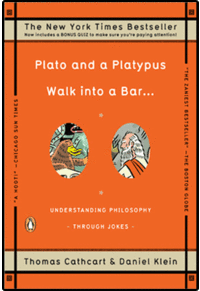
While I was familiar with various theories of humor or at least with the philosopher's who conceived of them, I did not give aesthetics much consideration until reading Plato and a Platypus. For the first time, philosophy made me laugh aloud!

Thomas Cathcart and Daniel Klein's philogagging made me roar with laughter at their humorous romp through philosophy... a particular favorite from their book is one that questions whether divine revelation trumps reason as a source of human knowledge or visa versa:

A man stumbles down a deep well and plummets a hundred feet before grasping a spindly root, stopping his fall. His grip grows weaker and weaker, and in his desperation he cries out, "Is there anybody up there?"
He looks up, and all he can see is a circle of sky. Suddenly, the clouds part and a beam of bright light shines down on him.
A deep voice thunders, "I, the Lord, am here. Let go of the root, and I will save you."
The man thinks for a moment and then yells, "Is there anybody else up there?"

It was in that moment that I firmly believed that all the years of devotion, time, and attention to acquiring knowledge on the subject of philosophy was worth it. My fascination with the history of human thought, professionally expressed in my preservation of human ingenuity, had given way to a new fascination, humor.

Life is far more interesting because of its inherent funniness. While humor during times of great sorrow is inappropriate and requires sensibility to avoid offending others, it is possible to keep it at one's disposal in the event the opportunity arises to utter something funny.

Visual Humor

Great ideas do not always stem from the _____ology/ics of something, sometimes they come from the back of a napkin, a sick utilized as a stylus for drawing in the sand, or pigment pressed on the palm of a hand and then slapped onto the wall of a cave.
If you're a visual thinker, like me, then visual explanations are important to understand and remember information quickly and efficiently.

Sifting through volumes of data, reports, projections, and simulations can cause the most interested shareholder to revert to the fetal position, thinking about nothing other than what they'd "rather" be doing.
With the help of visual aids, however, even the worst projections become interesting visual metaphors worthy of extended contemplation, and if you're lucky, riddles worthy of solving.

Presenting information Zenfully humorous is an art as well as a technique. The visual aid chosen is not intended to provide a complete overview of a concept, but rather a poignant concept that, when conveyed through imagery, helps viewers grasp the essential points of a subject in a short period of time.

Images should be honed to the immediate task for the best reaction. They should also overload or exaggerate the main concept.
Documented since antiquity, caricatures are one of the oldest forms of pictorial humor. Humor combined with visual art is found in Ancient Egyptian, Roman and Greek iconography (Wright 1875).

Hogarth, and after him Rowlandson and Gillray, were famous British caricaturists of the 18th century, while the French dominated the genre in the 19th century with Gavarni, Daumier and Doré. By the end of the 19th century, German "cartoonists" such as Wilhelm Busch, Heinrich Zille, Thomas Theodor Heine, Rudolf Wilke, and Olaf Gulbransson emerged.

What all these comics have in common is their well-crafted visual representation of humor - the methods rather than the process. The drawings direct our eyes to what's out there, tells us what we're seeing, and either shows us something we've seen before or conversely, never seen before. Basically, the artist draws something which begs the viewer, "When you look at this, do you see what I see?"

Asking and answering these questions visually brings to mind Dan Roam's six basic visual frameworks from which he states all other possible representations are derived, including the portrait.

Essentially, visual humor has to match answers to questions, be it financial, social, political, or gender oriented, and if you can squeeze in two meanings simultaneously, as with a visual pun, you've activated two scripts at the same time that often evokes incongruous concepts.

According to Christian F. Hempelmann and Andrea C. Sampson on Visual Humor (p. 615-616):
"Visual puns are difficult to transpose into the verbal domain."

"A visual symbol for the concept of knife" ... "Must always resemble that which it stands for, as this resemblance is how the concept is evoked. Such a symbol could not, for example, be round like a circle, but must be elongated and pointed, regardless ofhow much it is abstracted or may rely on content in a picture, such as a symbol for an object that is cut with the knife or a symbol for a hand that holds it."

Visual humor lies in the hands of those who are playful with their visualizations - relating these concepts central to humor, depicting, expressing, and reflecting highly complex emotional states or intellectual concepts in a work that requires little or no subtext.
Subscribe to:
Posts (Atom)