Showing posts with label choice. Show all posts

Wednesday, May 27, 2015

Truth and Beauty

The books that help you most are those which make you think the most. The hardest way of learning is that of easy reading; but a great book that comes from a great thinker is a ship of thought, deep freighted with truth and beauty.
~Pablo Neruda


Lost Ship

Truth and beauty are of vital significance (like pain and pleasure) and are awakened by the rhythms that arouse our receptive sensibility and prepare it to react in a special, intended way. Once aroused our entire experiential system is activated. 

The natural emotions do not reverberate alone; they enter, sometimes softly, sometimes vehemently into the network of our sentiments, which activate our imagination, our ideas, and our values. Sometimes they arouse us to levels barely perceptible, even to our keen radar; sometimes they evoke within us the unfolding of an entire work of foreboding art. 


Dwa światy


Truth and beauty, pleasure and pain, are filtered through our most intimate of personal tastes: inclinations, tendencies, imaginings, ideals, and moral sentiments. They flow through us, but their imprint upon our biological mechanism is coarse, and leaves behind a vital mesh intimately woven between the flesh and our existence of the world. 
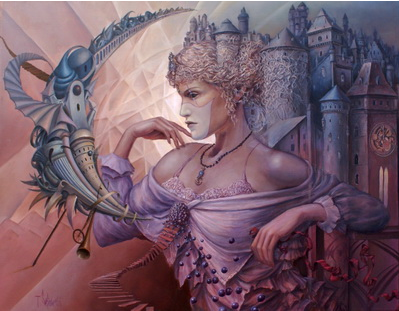
Zła Królowa


One might think Truth and Beauty stand apart from each other, but it is precisely where the focal points of their joint association come together that they expand outward. Standing on the precipice of eternity, on the furthermost side of our essence's abyss, hover over a ridge looking out over the horizon intuiting only that distance that separates one from one's own thoughts ... we see

Truth often feels like life's most crudest of realisms. Alone it depicts life as a mere factual reality, but with Beauty's mirror, truth's inner core is revealed, and reality expands, transforming in its wake those filters that encompass our multiple spheres of reality into a moving sentiment of spirit. The spirit in harmony with its truth respects established patterns and inner laws of reality proper to drive forth the mechanism toward acquiring life. 

Księżycowe Miasto


Lightly suspended, hanging from the lyrical cord of reason, is a quiet essence apart from the civilization of thoughts we carry forth through this sea of existence. It is precisely herein where we encounter those inner truths that can be harmoniously expressed through all sensible encounters, either expressed or sent our way by others. 

Protecting this silent sound in the wake of a tempest modulates and transforms the spectrum of receptive sensibilities toward innermost acceptance and resignation, joy over the order of things, and reconciliation. Here we are creative with our emotions, feelings and sentiments. Here we reach back toward the highest elations of metaphysical experience where we might soothe the pain-redeeming process and set it free, back on the path toward those lyrical chords that resound throughout reality; the ones most natural and most lovely amid Eternity's selections are the ones I choose to see. 

Bez tytułu


Thursday, December 5, 2013

The Natural Beauty of Naïvety

Boy Blowing Bubbles (1867)
Édouard Manet (1832 - 1883)
Provenance: Albert and Henri Heicht, Paris; Emmanuel Pontremoli, Paris, 1916; Bernheim-Jeune, Paris, 1916-1918; Durand-Ruel, Paris, New York, 1918-1919; Adolf Lewisohn, New York, 1919; Bought through André Weil, New York, November 1943. 
Calouste Gulbenkian Museum, Portugal


There is an immortality in naïvety. For a child, this naïvety is a natural occurrence, but for an adult to perform the spontaneous reduction, hopelessly entangled in a similarly felt aesthetic consciousness where the mind disconnects and the corporeal realm of existence experiences the world from a sense of pure desire, the a priori of the experience is a kind of mechanism that one must put to work within oneself while simultaneously suspending volition, disconnecting the continuous, direct acts of one's own will. 

The moments that arise are authentic and adequate, and sufficient enough to neutralize the absolute observer in oneself. Thereafter, a projectional balance in understanding becomes the authentic adult being. Naïvety updates the mental facility according to the understanding of what being actually means and what has to be done to keep being in its existential status. 


Soap Bubbles (1859)
Thomas Couture (1815 - 1879)
Provenance: John Wolfe, New York (until 1863; sale, Leed's, Old Düsseldorf Gallery, New York, December 22–23, 1863, no. 129, as "Day-Dreams" or "The Indolent Scholar," for $4,750 to Hoey); J. Hoey, New York (from 1863; sold for $5,000 to Sanford); James T. Sanford, New York (by 1864–at least 1867); Catharine Lorillard Wolfe, New York (by 1876–d. 1887)
The Metropolitan Museum of Art, New York


There is an immortality in naïvety, a kind of play between acquiring knowledge and understanding. The feeling of flexibility and an image of flickering possibilities instead of solid pictures which transform those faithful renderings of the visible world into a playful domain that ousts the absolute observer in oneself in order to protect the genuine thinking involved in formalizing a thought.

The rational tools are set aside to keep oneself existentially awake and alert. The mind reflects upon itself constantly, entering back into self-consciousness, but for a few moments there is a balance between existential awareness and intellectual reflection.

From this point of view the existential status of being casts one away from the formal knowledge held in self-consciousness, toward a delightfully enchanting game of bubble blowing.


Soap Bubbles (ca.1733-34)
Jean Siméon Chardin (1699 - 1779)
Provenance: Louis-François Trouard, Paris (until 1779; his anonymous sale, Paris, February 22, 1779, no. 44, as "Deux tableaux pendans; ils représentent chacun un jeune garçon vu à mi-corps; l'un s'amuse à faire des boules de savon, & l'autre un château de cartes," canvas, 23 x 24 pouces, for Fr 95 to Dulac); ?Antoine Charles Dulac, Paris (1779–1801; his sale, Paillet and Delaroche, Paris, April 6, 1801, no. 19, as "Deux Tableaux . . . l'un représente un écolier qui fait des bules de savon; l'autre, une jeune fille qui fait lire enfant"); Jacques Doucet, Paris (by 1899–1912; his sale, Galerie Georges Petit, Paris, June 6, 1912, no. 136, as "Les Bouteilles de savon," for Fr 300,500 [with no. 135, "Le Faiseur de châteaux de cartes," for Fr 190,000]); David David-Weill, Paris (1912–at least 1933; cat., 1926, I, pp. 25–26, ill.); Fritz Mannheimer, Amsterdam (until d. 1939); his widow, Jane Mannheimer, Amsterdam, and later New York (1939–49; held in Paris for Mrs. Mannheimer at Chenue; seized by the Nazis and "bought" May 12, 1944 through Posse and Mühlmann for Fr 800,000 for the Führer Museum, Linz; held at Alt Aussee [1387] and at Munich collecting point [1588]; returned to France, January 30, 1946, by the Service Français de la Récupération and restituted following agreement with SNK [Netherlands Art Property Foundation] in or after 1948; sold to Wildenstein); [Wildenstein, New York, 1949; sold to MMA]


There is an immortality in naïvety. Blindfolding oneself from the faculty of judgment, an irony arises, that highest and most advanced form of existential self-awareness. Receptive minds perceive the experience from a natural standpoint, reflective minds perceive the experience from the other side of the painting. 

One's experience of these boys blowing bubbles is orbited into two halves ~ a being in the center of experience, a being serving as an absolute observer. The irony is the ability to choose, to change one's focus of observation, to extend a possible horizon of experience or even blow one's own bubble past it. 

Soap Bubbles (c.1784)
Johann Melchior Wyrsch (1732 - 1798)
Musée des Beaux-Arts et d'Archélogie (Besançon)


There is an immortality in naïvety. A mental journey between "yes" and "no", between extremes of spatio-temporal simplicity and existential multiplicity, between "doubt" and "certainty", "desire" and "fear".  

The techniques one acquires and then reduces give rise to a sensory perception of one's own subjectivity.  Enhanced by the notion of "light" and "dark", the contrasts clearly defined in these experiences are mirrored in these works of art, both represent a simple musing on the ephemeral nature of life. 

Symbolized by simplicity, naïvety becomes the most singularly sought after experience for one wishing to rediscover the feelings held in delight. 

The thoughts considered under the spell of enchantment are what make these paintings timeless. The experiences felt under the spell of enchantment are what make naïvety an immortal occurrence.