Showing posts with label Free Will. Show all posts

Sunday, November 12, 2017

Rosencrantz & Guildenstern Are Dead

CONTENTS
  1. The movie
  2. Leaf Falling Example
  3. Determinism
  4. Random Snoopy Example
  5. Flower Plucking Example
  6. Hume
  7. Bart Simpson & Dobby Example
  8. R&G Are Dead


The Movie

Rosencrantz & Guildenstern Are Dead is a Tom Stoddard flick about free will against the plot of Shakespeare's Hamlet. It illuminates the philosophical debate between Hard (or, Soft) Determinism vs Libertarian Free Will or Hume’s compatibilism. It is a theatrical query on whether or not life is determined, or whether we have free will. 

Leaf Falling Example

If you take for instance the leaves falling from the trees in a Northern Hemispheric winter, you might say the leaves had to fall due to the presence of a hormone in leaf-dropping trees that signals a chemical message to every leaf to essentially, “Take a dive!” 


Once this message is received, little cells appear where the leaf stem meets the branch. They are called “abscission” cells. Like their namesake, “scissors,” they cut themselves free. 

Determinism

In this sense, a leaf must fall. Its prior causes necessitate later effects. It is the leaf's fate to fall; it is already determined. 

Random Snoopy Example

“What if the wind picks up and blows the leaf off the tree?” 


That’s a good question, Snoopy. 

In this scenario, it appears that the leaf’s fate is random, i.e., not-determined. It can be affected by additional forces. Since the presence of random is not under our direct control, there is still no free will.

Hume

But what if your tribe is seated at the same campfire as Hume? 


You may retort the notion of determinism, saying that free will does not mean to do other than what you actually do, nor is it something that happens other than what actually happens


It means, doing something you want to do, regardless. 


Flower Plucking Example

Here, we pluck a flower and put it in our hair. Adorning ourselves with nature’s beauty. We exercised free will when we chose to pluck the flower. We seal its fate in our own story. 


Was the flower going to wither and fall, regardless of our action? Yes. 

Did we exercise free will? 
Yes. No. Maybe?

Bart Simpson & Dobby Example

Consider instead a more serious topic, one of life and death. 
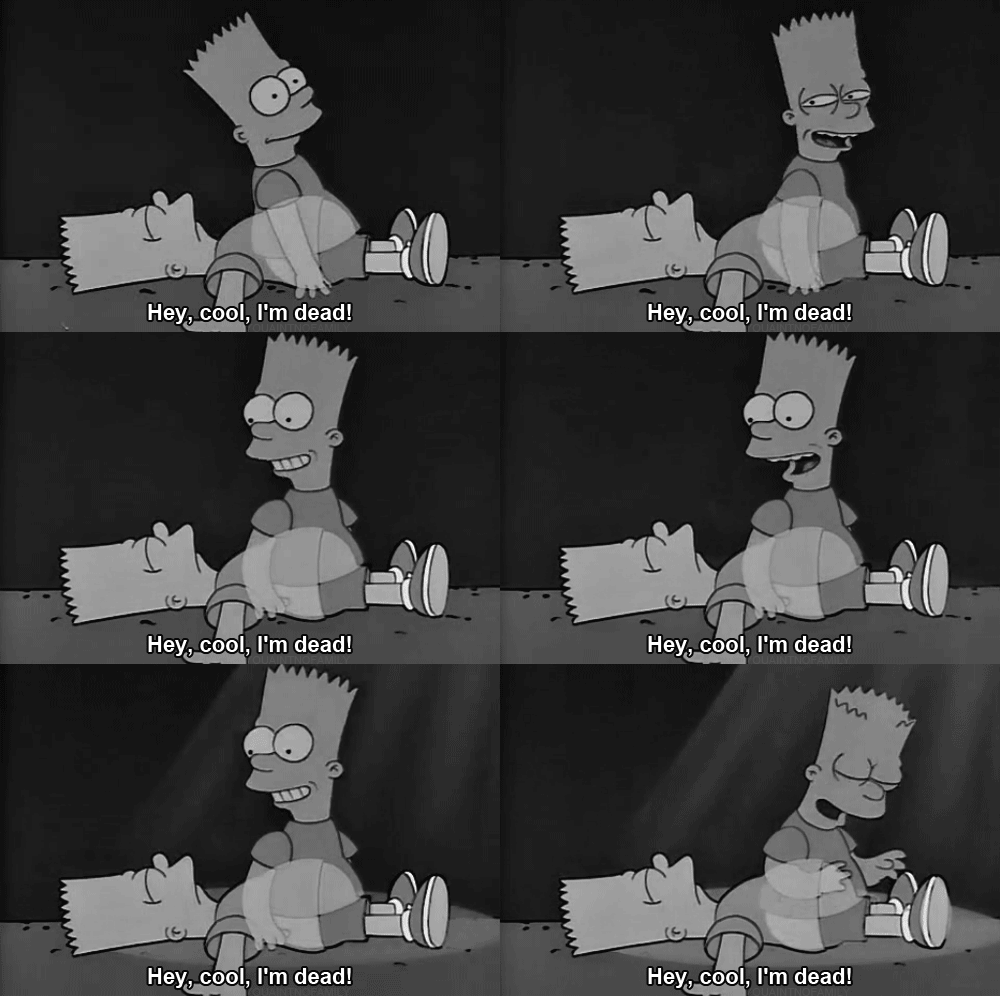

In this scenario, we as human beings cannot escape death. We are still trapped in the cycle of birth and death (regardless of whether that cycle is singular or plural; get it? This image of Bart dying over and over is a gif. It keeps playing). 


We still die 
(dramatic pause), 
eventually. 

But if we had a choice, we may not choose death. The fact that is not our choice to make indicates that we have no free will. 


This is the dilemma of determinism, 
Dobby.


R&G Are Dead

In R&G Are Dead, both realize they are trapped. Literally living out a certain set of actions. In their realization, they still "decide" (free will) not to tell Hamlet, which ultimately leads to their deaths, the climax of their roles in the play Hamlet. 

Oh, and, by the way, 


Heads or tails? 

"Free will is a revenge theory.
We cannot answer the question of who wins."
~Soph Laugh


Wednesday, March 30, 2016

What Am I? Personal Identity and the Nature of Chrysanthemums


Questions of personal identity occur to everyone at some point in time: What am I? When did I begin? What will happen to me when I die? Other questions are more abstruse. 

Who am I? 

We often think of "personal identity" as that which defines us. Our personal identity is that which makes us unique as an individual and different from others. It is the way we see or define ourselves, and the network of values and convictions that govern and bring structure into our lives. You could say that an individual is a property (or a set of properties). Presumably personal identity is fluid - we might have one today that is different than that which we had ten years ago, or will have ten years from now - which begs the question, which identity was ours, and is personal identity even a thing (since it is continually evolving)??

Personhood 

What is it to be a person? What is necessary, and which answers will suffice for that which we call person as opposed to non-person? What does a person have that a non-person lacks? 

In other words, how do we define person

A philosopher would answer this question like this: 
"Necessarily, x is a person if and only if ... x ...", with the blanks appropriately defined. 
More specifically we can discuss at which point in one's development from fertilized egg do they become a person, or what would it take for a Chrysanthemum to become a person?


Chrysanthemum

What would it take for a Chrysanthemum to become a person - that is, for a Chrysanthemum to exist with properties associated with personhood? What sorts of things would have to happen for us to look at a Chrysanthemum and call it a person?

If a Chrysanthemum sang to us, or spoke to us, as the flowers sing and speak with Alice (in Wonderland), would we then consider that Chrysanthemum a talking or singing flower, or would we consider that flower a person?

Which properties must specifically exist for us to consider an entity a person? Who determines which properties defines personhood? Suppose I point to a Chrysanthemum and call it a person. What makes anyone else so certain it is not (a person)? What is it about absurd questions that heighten our understanding of selfhood in a way that addressing it directly does not? Why do philosophers ask so many questions? I digress.


An Answer

An answer to why we do not call Chrysanthemums persons lies in persistence conditions, or in a criterion of personal identity over time (a constitutive rather than an evidential criterion: the second falls under the Evidence question).

The reality is few people ask this question (about Chrysanthemums being persons), but just the same, asking this question arises out of hope (or fear) that we might not be that which we think (we are).

Plato's Phaedo is a famous example. Whether consciousness and other properties we associate with personhood could exist in a Chrysanthemum depends on whether life necessarily exists in one set of properties.

Imagine waking up tomorrow morning as a Chrysanthemum (much like how Gregor Samsa woke up as a giant bug). Would you still consider yourself a person? How would you feel about someone coming along and plucking you from your roots, only to place you in a cold, sterile vase, as a centerpiece on their table?

What could you do about it, anyway? And is the ability to do something about it a property of personhood?


Evidence 

How do we find out who is who, who is a person and who is not a person? What evidence bears on the question of whether the individual writing this article or a Chrysanthemum growing in the author's garden is a person? What ought we to do when different kinds of evidence support opposing verdicts?

One source of evidence is first hand memory. Do you remember being a Chrysanthemum, or do you remember being a human being; and thus, a person?

Another source is physical continuity: Have you always been an individual (i.e., a person) or were you once previously a Chrysanthemum?

If you resemble a Chrysanthemum, or better yet, if the Chrysanthemum is in some sense physically or spatio-temporally continuous with you, is that reason to think you and the Chrysanthemum are one and the same person?

Can first-hand memory count as evidence all by itself, or only insofar as we can check it against publicly available physical evidence?

The Evidence Question dominated philosophical literature (on personal identity) from the 1950s to 1970s (Shoemaker, Penelhum). Despite sometimes being confused with the Persistence Question.

What does it take for you to persist through time; and how might we find out whether you have done so? 

If a Chrysanthemum has fingerprints, and those fingerprints were found at the scene of a florist's crime, and those fingerprints match yours, the courts might conclude that you are a Chrysanthemum.