Wednesday, April 4, 2012

Freud was a Dork

*Warning: Post contains explicit language
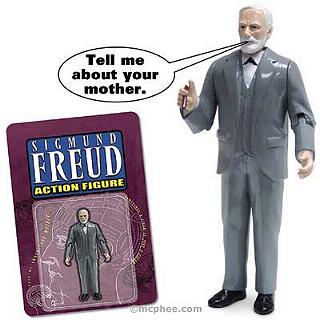
Sigmund Freud (May 1856 - September 1939), Austrian (dorktor) neurologist who founded the discipline of psychoanalysis was a dork. Not the unintelligent kind, but rather, the foolish, ass, halfwit, moronic, imbecile, major dum-dum, big time ninny, nincompoop, chump, *jackass, *dumb-ass, doofus, dipstick, lamebrain, and downright jerk of a schmuck-kind who convinced generations of like-minded people that he was brilliant. 


Freud tried to diminish people to their lowest common (reproductive) denominator. 

Let me explain...


The development of taste buds (vertebrate taste system) has been relatively understudied compared with other sensory systems. It was originally suggested that taste buds derive from placodal ectoderm, specifically from epibranchial placodes that lie in a ventrolateral position alongside the developing pharyngeal pouches. Granted, these placodes are very well developed, but how the central projections of taste afferents are mapped onto the cerebral cortex remains unclear. 


My point? Freud limited behavior to one common expression, a common error in human thinking (see tunnel vision). Essentially, when Freud suggested children go through four stages of development: oral, anal, phallic and genital; he missed entirely a whole world of perception that gives flavor to the experience of being human. 


A Ratioanalyst or a licensed vertebrate taste analyst (ratio is the Latin word for system) might instead have categorized our behavior according to four distinctly separate stages of development: salty, sour, bitter and sweet. 


These structures involved in perception constitute additional receptors from which our cells communicate with our brain and thus influence our behavior. 


(Out of 476 adults in Boston, Chicago, Los Angeles, New York, and Seattle, 54.2% of participants surveyed preferred Dunkin' Donuts coffee to the 39.3% who preferred Starbucks coffee.)


Freud, dude, I have one song for you... 


*Warning: Song contains explicit language
(Substitute Freud for Kyle)


In a nutshell, to lessen all human expression to the reproduction system is like diminishing Michaelangelo's iconic image of the hand of God giving life to Adam as nothing more than paint and spackel. Important to get the job done, but far from being a true representation of what it means to be human. 


Autism, ADHD and ADD Awareness Month


For centuries, people have tried to define intelligence, to put it in a box, and then contrast all other forms of human expression against it. 


I can't help but wonder if ADHD & ADD are instead expressions of undefined intelligence, yet to be explored, understood, analyzed, reanalyzed, forgotten for a few hundred years, revived in an obscure thesis, only to be published in a widely spread periodical that captures the public's imagination, garnering new interest and speculation, reevaluated based off of new medical findings and ultimately deemed, following a peer review, an example of another form of intelligence, an intelligence "possibly closer to the quantum level at which the entire known universe operations" and thus, the new measure of true, innate intelligence. 


I wonder...

Tuesday, April 3, 2012

Pacman Fever

Let's find out, shall we...


Watch this video


*Warning: There's a lame advertisement before the movie
Please be patient...


Pacman Fever


Pacman fever is a disease caused by the pacmangenic toxin (a bacterial pacotoxin) released by Pactococcus ghostenes. Once a major cause of quarter disappearance, it is now effectively treated with free downloads on sites such as Pac-Man Google, Flash Pacman, and my favorite, Free Pac-Man.  


The term pacmantina may be used interchangeably with Pacman fever, though it is most often used to indicate the less acute form of Pacman fever seen since the beginning of the 24 1/2 century.

Pacman fever was feared in the pre-digital era, as it was associated with the misconception made by lame adults regarding the entertainment activities of "hip" teenagers. The 1982 song, Pac-Man Fever recorded by Buckner & Garcia (the remix is above) was released as an LP, a cassette, an 8-track tape, and later completely re-recorded for CD release in 1999, and 2002. 


Epidemiology

This disease is most common in 8-22 year olds with males being more affected until after the emergence of Ms. Pacman, in which case both males and females became equally affected (see 1st video ending - the one all the way at the top of this post). By the age of 10 years most children have acquired protective antibodies that ward off the well-intended advice of their "not with it" parents and Pacman fever at this age becomes increasingly common. 


It is usually spread visually, by the watching of someone else playing the game, which you know you can play better. 

The incubation period is approximately one game to get you "hooked".


Microbiology

The disease itself is caused by the unbelievably addictive feeling one experiences while trying to gobble up those dots. Were it not for the ghosts, which act as inhibitors to the toxin, Pacman fever would hit the moment you grab onto the joystick


Symptoms and signs

  • Swollen eyes (from not blinking)
  • Blank staring (off into space, scanning for ghosts)
  • Memory loss (forgetting chores, like dumping garbage, doing homework, whatever)


Diagnosis

Diagnosis of Pacman fever is visual. The person with Pacman fever does not want to move away from the console. This person may resist suggestions to "turn the game off" or "take a break."  In advanced cases, this person may skip meals or in the extreme opposite, be surrounded by drinks, chips, and Ding Dongs, in an apparent attempt to not leave said gaming station. 


Complications

The complications of Pacman fever include acute Pacmanlonephritis, Pacmatic fever and Pacmanem. 

An association between Pacman fever and ADHD has been recognized for several decades. The mechanism of causation is not known. 


Clinical Notes

Swollen gamer eyes is the most striking sign of Pacman fever. It becomes recognizable when the person begins looking like they didn't sleep the night before. As the swollen eyes worsen, dark rings form underneath the eyes, giving the appearance of extreme exhaustion.

Psychics claim that the person's lifeforce is being "sucked right out of them" and that people who have too much exposure to electronics suffer from electronitis. No studies have yet been conducted to collaborate the validity of this claim. 


Treatment

Other than the occurrence of major complaining about the loss of said game console, the treatment and course of Pacman fever are no different from those of any gamer's disease.

In case of severe withdrawal, hold a HUGE POOL PARTY and continue EXTREME intervention methods until said person can come up with something better to do with their time. 


Note

An intervention-resistant strain of Pacman fever emerged when Ed Boon and John Tobias created Mortal Kombat, commonly abbreviated MK.

Rumors of MK's link to the Midway tribe indicate a common ancestor with the Pacmanin, a rumor which has floated around since the game was first released on arcade machine, though the move to home consoles is said to have displaced that myth. 


See also 


Monday, April 2, 2012

Pacman: From Lewis Carroll to Ancient Greece


In Chapter 4 of Lewis Carroll's Through the Looking Glass, Alice approaches the portly twins, Tweedledee and Tweddledum, who stand side by side with their arms around each other's shoulders. After some handshaking and dancing, and Tweedledee's retelling of the poem "The Walrus and the Carpenter," Tweedledee points out to Alice that she was just "a sort of thing" in the Red King's dream.


Jorge Luis Borge's poem, Circular Ruins, begins where this story's epigraph is taken: "And if he left off dreaming about you..."


In Borge's poem, a wizard retreats to a location of strong mystical powers: the circular ruins. Of these circular ruins, Borge wrote in his memoirs: "I came across a manuscript supposedly written by Sir Arthur Evans indicating that the circular ruins or platforms stand some 350 m west of the northern edge of the palace. The buildings are unique  in form for Bronze Age Crete, and appear to mark a period, the decades immediately after 1400 B.C. (within LM II-IIIA2), when the area, during the times it was built on at all, was not occupied by houses, but rather, a Pacmanin settlement."

Borge further disclosed in his unpublished memoirs that the character for his wizard was based off of Lewis Carroll's Red King.

The Throne Room

Dr. Laughing's team made the connection between Borges' memoir notes on Sir Arthur Evans' account of the circular ruins and platforms belonging to the Pacmanin settlement when at a private estate sale in Switzerland by an unnamed descendent of the father-and-son Swiss artist team, Émile Gilliérons Junior and Senior. The document they came across was stuffed into an old paint tin, but it was clearly written by the famed Sir Arthur Evans.

Sir Arthur Evans (far left) 


In the document, Evans writes:

"I have recently concluded that the Minoans and the Pacmanins might have coexisted during the decline of the Pacmanin's occupancy of the region, estimated to be somewhere around 1400 BC.  This would account for the dual thrones, the circular one for the Pacman and the traditional throne for the Princess, both of which are face-to-face.


I have chosen not to inform the Gilliérons, who have already taken much creative liberty with respect to the artwork I have commissioned, on the good advice of Mr. Fyfe, who warns me that Minos Kalokairinos still has considerable influence in the region.


Kalokairinos is convinced that the maze-like quality of the palace is based off the labyrinth, which had been built by King Minos to hide the Minotaur, a half-man half-bull creature that was the offspring of Minos' wife, Pasiphae, and a bull.


It is my belief that this creature was half Pacmanin and half Minoan, the name which I will ascribe to these people. This belief, though I have been warned not to make mention of it, is based primarily on the following drawings, in which I have come into secret possession...

Half-Pacmanin, Half-Bull

Three-quarter-Pacmanin, One-quarter-bull

Depiction of famed Ghost


The suspicion that the Pacman tribe occupied this region is further solidified by the circular form that the Minoan sealstones took. 


According to local legend, it was the Pacmanins who brought this symbol from Ancient Egypt, though the latter Minoan seals are much larger. The gem-grade seal-stone's impression is said to be representative of the famed ghost the Pacmanin tribe hunted out of Africa, and the bull dancing was said to be a reenactment of the Pacman's hunt of the ghost.  These coincidences lead me to believe that there is an undeniable link between the Ancient Minoan's and the Pacman."


Dr. Laughing's team is currently at the dig site and cannot be reached for further comments. Stay tuned for further information...


The Secret Life of Pacman


There is an obscure reference in the Iliad about a πρόσωπο κύκλο άνθρωπος, (lit. the man with a circular face) that has stumped scholars for centuries. Dr. Sophy M. Laughing just might be on to solving one the biggest enigmas in Pacman history...


In his opening of De Bello Gallico I, Julius Caesar, wrote: "Gallia est omnis divisa in partes tres, quarum unam incolunt Belgae, aliam circularis faciem populus Terra, tertiam qui ipsorum lingua Celtae, nostra Galli appellantur" (Gaul is divided in three parts, the first of which is Belgium, the second the land of the people with circular faces (...), the third which has its own language of Celte, as the Gallic people call it). 


Historians have speculated about the mysterious reference to "circularis faciem populus" or circular faced people as Caesar referred to them. He later went on to elaborate about the very unusual fighting customs of the circular faced men, namely that they preferred to do battle at night, when, quoting Julius Caesar, "quisque similis spiritum" everyone looks like a ghost...


According to Dr. Laughing, she is in possession of a letter written by Caesar outlining his plans to set out for the town of Gergovia. A notable piece of evidence to support Dr. Laughing's claim is the reference to how Caesar intends to defeat the Gauls. In it he writes, "I dreamed of a circular-faced man floating over the Gaul's territory, immediately I knew to encircle their camp and wait for the eventual starvation or surrender." 

This document confirms not only the existence of the circular faced people, but that the sight of one in a dream affected Caesar's battle strategy. 


In 1532, French humanist and writer Francois Rabelais wrote his famed opus "Gargantua et Pantagruel" about the life of two round faced giants by the same names. In chapter XXVIII, p. 181, Rabelais recounts how Gargantua accidentally swallows no less than six pilgrims while eating his salad...


While most scholars have posited to date that the narrative should be seen as a sharp critique of the Church, the recent discovery by Dr. Sophy M. Laughing is bound to re-ignite the debate. 

Could Gargantua and his son Pantagruel be nothing more and nothing less than the last of the Pacminins?


Sunday, April 1, 2012

Oldest known Pacman fossil found in Europe

By Sophy M. Laughing, Ph.D.

updated 4/1/2012 1:30 PM PT


Ancient Pacman Fossils


Périgord, France - The Pacman fossil unearthed in a cave in France is the oldest known fossil of a Pacman ancestor in Europe and suggests that Pacmin lived on the continent much earlier than previously believed, scientists say. 

The researchers say the fossil found today in Périgord in southern France, along with stone dots and ghost bones, is up to 1.3 million years old. That would mean that Pacman is 1.3 millions years older than the 1980s Pakkuman or Pacman arcade game developed by Namco and licensed for distribution in the United States by Midway. This finding has prompted the naming of a new species: Homo Pacmanin, or Pioneer Pacman, possibly a common ancestor to Pac Pong and modern Asteroids. 


The new find appears to be from the same species, researchers said. 

A team co-led by Sophy M. Laughing, Ph.D., founder of Nomadic Education, reported her team's find this morning and plans to send it to the scientific journal The Nature of Pacman. 

The timing of the earliest occupation of Europe by Pacman (Pacmin) that emerged from Africa has been controversial for many years. 

A cave painting of a ghost head from Périgord, dating back roughly 1.26 million years, bears traces of the mysterious Pacmanin Blue pigment.

Some archaeologists believe the process was a stop-and-go one in which species of pacmin - a group that includes the extinct relatives of modern Atari's, Jousts, and Spy Hunters - emerged and died out quickly only to be replaced by others, making for a very slow spread across the continent, despite the speed at which they gobble up yellow dots and eat ghosts. 

Until now the oldest Pacman fossils found in Europe were Homo Pacmanins. The Pacminin tribe is estimated to have migrated to Crete in the Mediterranean (see below). 

The Palace of Knossos is the main tourist attraction for ancient Pacmanin carvings in central Krete

Laughing's team has tentatively classified the new fossil as representing an earlier example of Homo Pacman antecessor. And, critically, the team says the new one also bears similarities to much-older fossils dug up since the 1980s in the Caucasus at a place called Dmanisi, in the former Soviet republic of Georgia. These were dated as being up to 1.8 million years old. 

"This leads us to a very important, very interesting conclusion," Laughing said. It is this: that Pacman, which emerged from Africa and settled in the Caucasus eventually evolved into Homo Pacman antecessor, and that the latter populated Europe not 800,000 years ago, but at least 1.3 million years ago. 

"This discovery of a 1.3 million-year-old Pacman fossil shows the process was accelerated and continuous; that the occupation of Europe by Pacman happened very early and must faster than we had thought," Laughing said. "Apparently, chasing ghosts improves your form, stride length, strength, flexibility, muscle memory and explosiveness - which means faster ghost chasing and dot eating times." 


A leading researcher in Pacmanin origins at the Natural Pacman History Museum in London and not involved in the project, said Laughing's team has done solid dating work to estimate the antiquity of the new Pacman fossil by employing three separate techniques - some researchers only use one or two - including a relatively new one that measures radioactive decay of sediments. 

"This is a well-dated site, as much as any site that age can be," said this unnamed researcher from London. 

But he also expressed some caution about Laughing's conclusions. 


First of all, the newly found Pacman fossil, which measures 35 cm in diameter and has teeth attached to it, preserves an almost complete Pacman fossil not before seen in the equivalent pieces found at Périgord and the time lapse is half a million years. 

"That is a long period of time to talk about continuity," said this increasingly grumpy, if not downright smug, unnamed researcher from London.

Still, there are similarities between the two and this along with the longest preserved Pacman unearthed in Siberia (pictured below in the jar filled with formaldehyde), suggests that southern Europe did in fact begin to be colonized from western Asia not long after Pacman emerged from Africa - "something which many of us would have doubted even five years ago," said the unnamed researcher who is now beginning to get with the program. 


Laughing says that with the finding of Pacman fossils 1.3 million years old in Europe, researchers can now expect to find older ones, even up to 1.8 million years old, in other parts of the continent. 

"This has to be the next discovery," she said.


"This is an April Fool's hypothesis." 


The True History of April Fool's Day


The True History of April Fool's Day...


Pope Gregory XIII issued a decree in 1582 and the date jumped from 4 October to 15 October overnight (in Catholic countries). Protestants were suspicious of this Roman slight-of-hand thinking they'd be robbed of 10 days of their lives. 

Britain and America did not adopt the Gregorian calendar until the 18th century; the Russians held out, astonishingly, until 1917. 

The Pope's adjustmented was needed because the Earth does not oblingingly circle the sun in an exact number of days. The old Roman calendar did not take accurate enough account of leap years, and the Easter Festival was getting warmer and warmer as the calendar year gradually slid out of synchrony with the seasons (kind of like it does today). 

Pope Gregory decreed that century years should not be leap years unless divisible by 400. This rule adjust things for 3,300 years. 

Recent refinements to the rule have put us right for another 44,000 years. 

Rumor has it, though, that the inhabitants of an island in the Outer Hebrides still have no intention of adopting the newfangled Gregorian calendar. 

Speaking about measurable time as if it were real, I myself seek enjoy paying hide and seek with the concept of a cosmological constant. I know it exists, but I don't when.


The wale of a tale Wikipedia told in lieu of the real story...


In 1564 King Charles IX of France, in his edict called l'Edit du Roussillon, gave nirth to what is referred to as the Gregorian calendar.  King Charles, the philandering scandal he was, reformed the calendar, moving the start of the year from the end of March to January 1.

However, in a time without trains, a reliable post system or the internet, news often traveled slow and the uneducated, lower class people in rural France were the last to hear of and accept the new calendar. 


Those who failed to keep up with the change or who stubbornly clung to the old calendar system and continued to celebrate the New Year during the week that fell between March 25th and April 1st, had jokes played on them. 


Pranksters would surreptitiously stick paper fish to their backs. The victims of this prank were thus called Poisson d’Avril, or April Fish—which, to this day, remains the French term for April Fools—and so the tradition was born.