Showing posts with label Descartes. Show all posts

Saturday, September 19, 2020

The Passionate Little Dinosaur


Hi, I'm a dinosaur. I'm the friend you never had, probably because I'm gonna tell you what I really think if you ask me. I may have a lazy opinion on many topics, but on that which I have an opinion, I would be remiss not to share. To this I readily concede. 

In business parlance it is what's called a bottom line approach. Either I see it, or I don't. Deep down, I think most people are the same way. If we like what we see it is entirely a matter of taste if we pursue it, or as Descartes calls it, it hits upon the passions. 

But what is it that inspires the passions? 

Wonder has a special feature: alone among the passions it doesn't involve any change of heart. The reason for this is that wondering at x doesn't involve value-judgment on x; ~it doesn't prompt one to seek x or to avoid it; ~all it involves is "curiosity about x"; a desire to know more about it. Hence it doesn't involve the heart, on which the whole well-being of our body depends, but only on the brain and the sense-organs which are used in gaining this knowledge

This doesn't prevent wonder from having a considerable impact because of the element of surprise, i.e. the sudden and unexpected onset of the impression that alters how the spirits move. This kind of surprise is exclusive to this passion: it normally occurs in most, having a strengthening effect, but only because wonder is intertwined. 

The strength of wonder depends on a movement that starts weak and gradually strengthens. It continues and grows and comes to life, while the original wonder was nothing but wonder. The proverbial snow-ball effect. The enthusiasm from which is steeped in novelty, which the brain likes very much. The strength of wonder and its corresponding effects depends entirely upon one's relationship with novelty. 

Novel objects are soft, less firm, than parts that have been hardened through frequent agitation; the effects produce in them by movements are that much greater. Typically we walk with confidence, upon terra firma without a care in the world. Hard surfaces are familiar. When our feet are met with feathers, the lighter and gentler contact of being tickled on the soles of our feet is almost unbearable to us, simply because it's not part of our ordinary experience. 

A stone and a feather can exist in harmony, so long as they remain independent. A stone will crush a feather, and a feather will tickle the stone until the stone can no longer take it. Anguish arises. This is the second step. 

Anguish is met with astonishment. This surprise has great power to steer Descartes' spirits in the brain, it contains the impression of the object of wonder - so much power that it sometimes drives all the spirits to that place, and gets them to be so busy preserving this impression that none of them carry on through to the muscles ... the upshot is that the whole body remains as still as a statue. A permanent smile etched for all of eternity

This is what we commonly call 'being astonished'. Astonishment is an excess of wonder, which is less than enjoyable. When one's tastes and passions are not represented, immobility arises and the person can perceive only one side of the wondered-at-object, namely the side first presented to him or her. If she weren't outright astonished  she could turn the object over, walk around it, or the like, thus learning more about it. 

Unearthing rocks should be handled with great care less they explode

It is good to be born with some inclination to wonder, because that increases scientific curiosity; but after we have acquired some scientific knowledge we should try to free ourselves from this inclination to wonder should we feel doing so is clouding our judgment and imposing upon our understanding

For excessive wondering there is but one cure: to acquire knowledge to deal with things that seem unusual and strange; ~not by wondering about them but by examining them. 

For excessive wondering there is but one cure: to acquire knowledge 


Therein lies the cool water that extinguishes the explosion. The outcome a measure of good timing, correct understanding, and self-understanding in relation to other. It sounds simple enough but even those equipped with good common sense have no external opinion of their competence. This is what makes it hard to cure "blind curiosity", a disease whose victims seek out rarities simply in order to wonder at them and not in order to know them. They become so full of wonder that things of no importance are as likely to grab their attention as things that it would be actually useful to investigate. 


Friday, September 15, 2017

A Fine Line between Philosophy and Humor


There's a fine line between being philosophical and being funny. Philosophy is the science of estimating values. Humor is the art of revealing them. The superiority of any state or substance over another is determined by philosophy, and yet the author of this blog registers all states and substances as equal in their existence, just not in their time/space/location/position along the rope of destiny. 

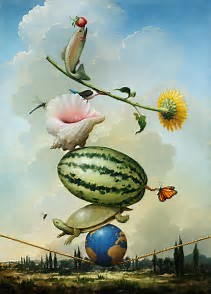
By assigning a position of primary importance to what remains when all that is secondary has been removed, philosophy becomes the true index of priority or emphasis in the realm of speculative thought. By walking that rope for yourself, the primary importance shifts to one single, solitary, a priori focus:

Don't fall!


The mission of philosophy a priori is to establish the relation of manifested things to their invisible ultimate cause or nature. The mission of humor is to point out the relationship in relation to something else, i.e., the absurdity of an elephant showing off his extraordinary balance.


If you consult philosophy's giants on the matter, "Philosophy," writes Sir William Hamilton, "has been defined [as]: The science of things divine and human, and the causes in which they are contained [Cicero]; The science of effects by their causes [Hobbes]; The science of sufficient reasons [Leibnitz]; The science of things possible [Wolf]; The science of things evidently deduced from first principles [Descartes]; The science of truths, sensible and abstract [de Condillac]; The application of reason to its legitimate object [Tennemann]; The science of the relations of all knowledge to the necessary ends of human reason [Kant]; The science of the original form of the ego or mental self [Krug]; The science of sciences [Fichte]; The science of the absolute [von Schelling]; The science of the absolute indifference of the ideal and real [von Schelling, again]; The identity of identity and non-identity [Hegel]; Trying is the first step towards failure [Homer Simpson]. 


RANDOM TIGHTROPE PICS
just beause


Saturday, March 19, 2016

Socrates, Descartes, and Marie Antoinette Walk into a Bar Salon


If you are alive today, and are in any way interested in intellectual matters, we probably would have thought we lucky to have come across one another to do more than think and write and fix and do things, we might sit down and wonder what we might really do if we put our brains together to tackle the understanding of Dabrowski's Theory of Positive Disintegration and the public's growing curiosity about it in a definitive way or we could marvel over the level of detail in Disney's 55h feature animated film Zootopia ... 


Charles Darwin showed how some emotional phenomena are present in remarkably comparable ways in nonhuman species; William James and Carl Lange advanced an innovative proposal to explain the processing of emotions; Sigmund Freud turned the emotions into the centerpiece of his often singularly twisted inquiry on psychopathological states; and good 'old Charles Sherrington tinkered around with a neurophysiological investigation of the brain circuits involved in emotions. 

Think about the early discussions Sherrington had with anyone would would listen to him? I wonder how many of those goodhearted gals and fellas were too busy to hear what he had to say, totally disinterested in going outside their comfort zone to even hear what he had to say, or simply incapable of taking off with him, through the keyhole. 


If Socrates, Descartes, and Marie Antoinette walked into a bar salon, an all-out attack on the subject of emotion, right there and then, would commence. Socrates would give an exhaustive, resolute explanation of characteristics only recognized when first experienced inside -thus, unheard to an audience. Descartes would blame himself, he'd plunge down that rabbit hole, head first. He'd only stop for tea if he could then think about the stopping for tea and its relation to thoughts theretofore previously never considered, and therefore necessarily worthy of examination, if only for the novelty, which is a must for the flourishing of a mind held hostage in a brain. 


What would Hilary Putnam have to say on the special subject of the brain-in-a-vat and the absence of trees in this artwork? Whatever it was, Socrates and Marie would have drowned out the sound of the discussion with their friendly, lively, and enjoyable discourse. 

It's no wonder Hilary et al got their little feelings hurt and turned around and under the loosely held group called neuroscience gave a resolute two fingers up to emotion research. 


True, the psychoanalysts never quite got over it, but a few pharmacologists and psychiatrists concerned with disorders of mood, and their twin cousins: a lone psychologist and neuroscientist, scientifically engineered an interest in the subject so that they'd have a place to share their shots on the subject; err, I mean, "thoughts" on the subject.   

Girl Selling Cupids, 1763
Joseph-Marie Vien

Traveling to the head of the Académie Royale in Rome, we look to this larger than life pilasters decorated scene of a beautiful aristocrat woman sitting in the center golden chair, her companion stands behind her as both women give their full attention to the young girl who sits on the floor with a basket of cupids. She shall select the cupid, and chooses the one with the blue wings. The little cupid itself extends his arm, wishing to follow his taste for the lightness of rococo with the grandeur of classical style. 

And what will Little Blue-Winged Cupid find? 

Innovation, emulation, and even resistance, revealing tension at the very heart of the creative approach. And thus returning full circle to Socrates, Descartes, and Antoinette's discussion on the noble states of human emotion. 


@_@ Wow. I'll have what she's having. LOL


Rather than invite judgment, which would have only raised a ruckus, ending in a row, the trio settled in for the evening to consider the mind's natural language, the errors in translating it, and what we can do about it, in terms of extracting as much nectar of the gods as is humanly possible from the experience without overtaxing the human mechanism. 

I hoped to hear more of what they had to say on the subject, and seated myself at the end of the bar with a shot of tequila before me, amen. My stage was set and they returned to their discussion, but I did get a welcoming, attentive, and generous audience when I laughed at the implications of a particular conversation they had on just which map they should consult when navigating the labyrinth of emotions to an imaginary land one calls the dwelling place of the human mind .... 

Yes, Descartes, all these years later people can't help themselves, they're still searching for what it is that operates from within or travels through affecting the proverbial landscape. 

 
Cityscape (1956)
M.C. Escher

Just as expected, all three were eager to engage in a conversation, pose questions, make suggestions, and offer corrections (at this moment, Descartes and Marie pointed toward Socrates, who smiled knowingly in return). In several instances I caught Socrates smiling, the seemingly endless knowing smile he often flashes. With the exception of his personal biases, most of which he is aware or can easily pinpoint when in new territory, he's annoyingly correct. 

Descartes would just squint his eyes as if filtering out the light in his mind's eye. And Marie, she was too busy attending her flock and writing out her correspondence to concern herself with such details. 


Ten short minutes later the situation was radically different. Not long after Descartes conceded to Socrates, did Socrates look to Marie as an example of how to live the good life. To have time to imagine, to dream, to wonder ... set in an edenic landscape, perched upon a hill under a beautiful shady oak tree whilst the children frolic about, skipping stones across the lake, tormenting (only slightly) the ducks who waddle about in toe. 

The natural language of the mind turned their attention to the necessity of each and every human expression, and whether or not hierarchy could be assigned to anything other than personal taste. The subject was greeted with a new attention. Marie was particularly engaged in this lively discussion, and brought petit fours to fuel the mind's insatiable need to expend the higher volumes of energy necessary to disconnect positively from the experience of living to consider the art of it. 


Descartes and Socrates struck up a side conversation on the relation between emotion and reason, both offering exhaustive explanations of every nuance conceivably imagined, only Socrates was able to keep his place in the dialogue without the aide of notecards to find his way back from visiting a tangent. 

Descartes made a joke about keeping record of the categorical twists and turns so that he might later return to the subject, categorize and analyze and publish yet another book on the subject of how one goes about traversing and coming back full circle from a tangent, which he admitted was the basic plot in his book, only readers made it about the subject matter. 

Hopping over the boys' loops of reason, Marie offered a novel idea: How about we leave let alone, and rather than disturb it, commonly assume it is working well so that we might instead turn our sights to novel information, allowing ourselves to fully experience the enterprise of receiving new information before the reason rushes ahead of us telling us what we're seeing and why we're seeing it that way, forever clouding an otherwise sunny disposition. 


She had a good point, I thought. Despite the raised eyebrows Descartes offered, Socrates was game, and the three settled in for what looked like would be a charming, witty, tantalizingly surprising debate. If one were a painter, they'd probably place objects of curiosity about the image, in a right in front of arcadia-type of scene, suitable for reasoning, but in some superficial versions of the work disinterested in human suffering, except for that which is self-imposed. 

There are others who prefer the topic of suffering, but those hopeless romantics heard what they described was a magic pipe being played by a well dressed man in multicolored clothing and they immediately turned around and followed him out of the bar. Last heard they were headed out in search of the legendary town of Hameln. 


Clearly the emotions are not a substitute for reasoning, but in some superficial versions they sure do make a lot of noise, and if you follow them instead of your reason, who knows where you'll end up. 

Precisely, chimed in Marie. 

And for that reason, Socrates, the Trojan-hearted war hero stands guard. To be sure, even Marie's squirrels and birds responded to external threats without thinking anything out of the ordinary for doing so. In effect, the bar was situated in a little refuge, surrounded by animals, adorned by bouquets of flowers. The sole lovers of Marie, upon whom she swooned each and every afternoons she could escape the many requests for her presence. 

A pure pleasure pavilion for her favorites, out of the public eye ... quiet living where friends, children, and on occasion, her suitors could be entertained. Indulging passions for tapestry-making, and rejecting the trappings of royal status, everything was just so, according to how Marie wished it to be. 

And how did she wish it to be? 

Charming, naturally. A place where a personal vision could be discovered in an unspoiled, verdant paradise of the kind so dear to her contemporary, the romantic genius of Jean-Jacques Rousseau. In him she recreated the unaffected, country life became her muse through which she walked, dreaming of her personal vision of the natural world. 

Descartes found it utterly charming, and indulged in a remodeling of his own landscape, while Socrates, lied on his side, perched up on one arm, thinking ... while slowly sampling a feast of petit fours Marie left for his delight and enjoyment. 


Marie sought to recreate the landscape of her mind's eye, in doing so gossip flourished. The City Officials passed a decree claiming authority to close down the bar in which she, Descartes, and Socrates invited all willing creative intellectual sorts privileged access. Why only the other day a very disagreeable man ranged against the establishment a whole coterie of ill will, having everyone believe the renaming was a blasphemous act, thus. 

Ignoring him entirely, Marie, Socrates, and Descartes resumed their conversation, surrounded with a living, natural scenery. To this end, they devoted themselves to overseeing work on the subjects at hand, writing to their friends about their intentions. 

All were delighted with the new idea plantings and engaged enthusiastically with their friends. 


With the unpleasants at bay, Marie focused first and foremost on her garden. She did not enjoy the considerations associated with Gabriel's architectural masterpiece, deferring those thoughts to the more industrious among her guests. Instead, she was concerned with the so-called "lesser" arts, the legendary landscape she felt necessary territory to house such a grand and novel philosophical adventure. 

She recruited those with a passion for agriculture to plant for her a living testament to her sense of style, to a style in which human sentimentality naturally flourishes as a gift of gratitude for the few moments in which she too might enjoy the space. While she respected the structured design of avenues and formal flower beds, they bored her. She didn't so much want to tame the landscape, but to see it flourishing. She devoted herself to searching out the rarest exotic plants and shrubs. 

Descartes graciously offered to devote himself to the deeper consideration of the botanical garden and its scientific approach, while Socrates, had now managed to get up with the aim of strolling through any part of the garden where his mind could tell him he was instead in the middle of a wild nature, free from the confinement of the royal greenhouses. 


Enchanted by the accidents of nature, Marie's gentleman gardners set to work, despite some reluctance on the part of the finance minister to cover the costs, which were judged excessive. Such was the price Marie felt should be justly paid, if only for the privilege of enjoying such delights. 

Why should such an obscure story of the mind's natural language as told by Socrates, Descartes, and Marie be of interest to a world more concerned with the trappings of how? 

It shouldn't, but it makes for entertaining consideration, if only for the author and those who visit her retreat, which she embellished with a "natural" beauty belonging to that of her beloved hamleau, the paradisial playground she adored. 

Happily wandering about her Temple of Love, in the dappled shade of two weeping willow trees, with paradise apples growing in the garden, white pelote de neige roses, and liliacs and lavender, little ideas were launched, on everything from natural encounters to thoughts thereon. 

This little bar into which Socrates and Descartes stumbled, was that of the gracious Marie, who could engage in lively debates with the best of them, but only so long as to not bore polite company, which she often felt was more appreciative of her petit fours than of her intellect's rational discourse. 


That was, until Socrates and Descartes came along. They enjoyed both. And with this pairing, a new fashion for intellectual gardening was born, and the ladies of California were eager to follow suit. 

And with that, Marie set out to work in which appeared on the surface as childish behavior, simply to entertain her new guests. 

Decades later, after this legendary event, descendants of Socrates, Descartes and Marie began to think radically different. Some ventured in search of understanding their feelings, some went off in search for how those feelings came into being, and those in America and Europe turned their attention to other matters, such as designing iPhone applications to cultivate subjects that required little mental attention to consider. The more industrious of the group set out on capitalizing on the secrets and became wildly popular. 

In the end, they walked out the doors of the bar, stood upon the precipice between emotion and reason, and jumped into a neighboring flowerbed, without regard for reason or overwhelming sentiment as a driver of human behavior. 


Precipice 2014


Monday, July 20, 2015

Kidding Ourselves


I recently had the pleasure of playing a game called Liar's Poker with two people whom I know well. Together with a family friend, we played a few rounds of friendly card games, Liar's Poker being the funnest of them all: assuming laughter is our measure of agreed-upon consensus. 

Liar's Poker is a delightful game of kidding ourselves and kidding others. Only, the best liar's win! Consistently, that is ... 

On occasion us literal folk "Get Lucky!"


What does luck have to do with winning? 


Jerome K. Jerome once said, "It is always the best policy to tell the truth, unless, of course, you are an exceptionally good liar." 

Bravo, Old Chap!


Couldn't have said it better, myself!


As much as we'd ALL like to think of ourselves as "good liars" the reality is, 

"It is hard to be a good liar, even when it comes to your own intentions, which only you can verify." 

[Steven Pinker, How the Mind Works, pg. 421; Kidding Ourselves].


Occasionally lying is about luck. After all when someone "pulls off" a lie, they often feel "lucky" that no one was paying close enough attention. In a game of paying close attention to what one is doing in relation to other, it is simultaneously the art of paying attention to what other's are doing. No easy task depending upon the mindset. 

Closely related behind luck lies a mindset. The mind that pays more attention to itself -vs- the mind that pays more attention to others. 

Emotionally charged, highly complex, high intensity people generally pay more attention to their own thoughts, with the thoughts of others providing them with a never-ending stream of fodder for analytical self-examination. 

The result of this Descartian-like examination is a direct projection of the individual's primary or core objective; be that "have fun in life" ... "give to others" ... or "sit back and take it all in" ... and then do - or don't do - something about it. 

It is one of these primary motivators which fuels the person's emotional system, the feel-good or feel-bad modulator of whether or not we have achieved our goal (relates to our perception of reward and punishment). 


Lying well is equally distributed across the range of personality types, with quiet people making the best liars. Quiet people are perpetually overlooked, even by those closest to them; those who generally do most of the talking. 

The persons doing most of the listening learn the most. Those who do most of the talking are often times their subjects; unless they're not actually paying attention. Some quiet individuals are just as focused on themselves as are their more voiceterous counterparts. These masters of letting others take center stage quietly and un-perceptively disappear into their own worlds while others rattle on. 

The hidden declarations behind those things we don't intentionally share are as visible as the things we do share - to someone who is paying close attention. The Reader, like the quiet person, considers the author or speaker in relation to the penning or rhetoric. Even if the author or speaker thinks him or herself removed from the subject matter at hand, the existence of the link itself serves as an indicator of relation, irrespective the density of the thread connecting the two - with the connecting thread precisely matching our perception of self in relation to other. 

Gorgeous Bad Boy of Neuroscience
Steven Pinker


According to Steven Pinker, intentions come from emotions, and emotions have evolved displays on our faces and bodies. He goes on to say that unless you're a master of the Stanislavsky method, you will have trouble faking them; in fact, they've probably evolved because they were hard to fake. 

Expressionism is a quality of inner experience, with the emotions or expressive qualities communicated through emphasis and distortion, which can be found in the below artwork by Charles Lebrun (French, 1619-1690), Expressions of the Spirit's Passions, c. 1663, engraving.


Lying is no easy task. In fact, it's downright exhausting - more so if it is with someone whom we are close because they are more familiar with our responses. 

In this respect, Liar's Poker is a fascinating game to play with others. To see if you can recognize the telltale markers of elevated breathing, half-smiles, and those little twinkles someone gets in their eye when they're being playful. This is what has attracted generations of people to card games. 

Just as *an artist must say without saying, so too a liar must distort their hardwired responses. These hardwired responses are the rationale behind polygraphs, the so-called lie detectors. They are also the rationale those highly skilled people evolved in lie detection utilize. The more often the utilize it, the more so-called Machiavellian we consider them. 

Analytical individuals skilled in observation and analysis make the best liars. Natural liars are those individuals who quickly dispose themselves to mimicry. These human mimickers learn to utilize mimicry as their form of communication. Mimicry slows things down to a respectable pace, one conducive of deeper examination. 


In many religions lying is a BIG NO-NO. To whatever philosophical belief system one ascribes, lying is universally recognized as something we shouldn't do. The notion of "right" and "wrong" are associated with reward and punishment. With all of life's experiences reinforcing this concept from birth forward, it is no wonder there is so much to learn by playing games where kidding and concealing take center stage. In terms of polite social interaction, Liar's Game is very provocative. 

For those forever trumped by their own knowledge, there's the annoying fact that some propositions logically entail others. These poor beings are essentially in possession of knowledge they must continually assess in terms of its relevance or value to a given interaction. 

One might respond to this discriminating challenge with resentment, in particular if one leans toward divergent interactions; however, one might also respond to this experience as an invitation to play, an opportunity to learn more by joining in someone else's sandbox to play the game from another's point of view. 


Games that allow us the opportunity to kid ourselves and kid others heighten our ability to recognize our self in relation to other. Independent of where we are in relation to our understanding of self in relation to other, opportunities for further understanding of our intentions and the intentions of others emerge. From the delightfully surprising information we gleam from the experience to the new strategies we develop to the bigger pictures we envision, games of self deception allow us to examine the theories we hold, conscious and subconscious, alike. 

The conscious mind sometimes hides the truth from itself in order to hide truth from others. The result is that truth is hidden from our own examination. These hidden truths sometimes serve us well, but not always. 

If one wishes to leave their lives up to chance or luck, then by all means, enjoy the unveiling, one card at a time. 


If you're the type of person who wishes to look at the hand you're holding prior to betting, or if you're a person playing to win, the ego's defense mechanism (such as repression, projection, denial, and rationalization - the most cunning human mechanism) is your mentor. For these people truth is useful. In this mindset truth is registered as a "utility" and walled off from the parts that interact with others. 

No wonder the notion of Freud and the subconscious play center stage. When one is more inclined toward disbelief and skepticism, one resonates with skeptics like George Orwell and cynics like George Castanza. For these types of individuals, there is always a hidden secret to be exposed. What one does with that is entirely a matter of taste. 


Then there are those people who good-hearted, well-meaning people who regularly look under the surface. How far they perceived can only be assumed by their actions. Someone who resonates with the above quote might resonate for a variety of reasons, while others might say something like: 


There are some individuals who still think of others as a potential playmates or future best friends. These individuals retain larger portions of that early childhood playground brain in relation to others where there is no need for lying, as it only gets in the way of having a good time. 

But what about those phenomenologists, you ask? 


Phenomenology inclines one to seek out wisdom writings, the thoughts of great statesman, writer-thinkers, lovers of wisdom, poets, and enlightenment thinkers ...such as Abraham Lincoln, Cicero, Plato, Octavio Paz and Voltaire. 

But what about François La Rochefoucauld? Didn't he say that, "Our enemies' opinion of us comes closer to the truth than our own." 

Maybe what Rochefoucaul was really saying was that he thought about others so much that he presumed they thought a lot about him, just as often. 


Not from what I've observed


In reality, people spend an extraordinary amount of time thinking about themselves - not others. Ludwig Wittgenstein said that, 

"If there were a verb meaning "to believe falsely," it would not have any significant first person, present indicative." 

What do you think, Mr. Twain?  


Mark Twain told us that there was one surefire way to find out if a man is honest: 

Ask him, if he says yes, you know he's crooked.


According to Twainian logic, 
I'm crooked


I didn't realized I was "crooked" - or did I? 

You see, that's just it. It is difficult to see clearly the emotions without first filtering them through our own lens, without examining them in relation to how we perceive the world. We can only know of another's intentions according to our own perception and our belief about where others are in relation to our perception, be it hidden or revealed. 

Neuroscientist Michael Gazzaniga has shown that the brain blithely weaves false explanations about its notions. In terms of how the brain is wired, we can be actively utilizing one side of our brain without the other side being aware of it. This anomaly is best understood when considering the split-brain patients who have their cerebral hemispheres surgically disconnected as a treatment for epilepsy. 

Hundreds of experiments in social psychology tell us that people present themselves to others by putting themselves in the best possible light. 

Stepford Wives

A reader of Garrison Keillor would describe the fictitious community of Stepford as one of those places "where the women are good-looking, the men are smart, and all the children are above average." 

Sounds like Silicon Valley...


Most people consider themselves above average in the traits they value most: leadership, sophistication, athletic prowess, driving skills, physical appeal or beauty. 

When these people play Liar's Game they attribute their success to their own skill and their failures to the luck of the draw or to their idyllic adherence to honesty. When they are fooled by a game or experiment, they consider it a compliment to their singularly focused goodness, to their true nature, which is always registering due north.


For these people there is no contradiction between "It's hard to lie" and the proposition "I didn't realize lying was so cunning." 

According to Eliot Aronson these people doctor their beliefs in order to contradict the proposition "I am nice and in control." 

Besides, who would want to believe otherwise? Doing so would be blatant evidence of otherwise, that we are not as beneficent and effective as we would like people to think. The urge to reduce the distinction is the urge to get our stories straight. 


It's one thing to grasp the deception of others, it's another to glimpse our own. There are moments in the game when little nerves are activated. If everyone knows when we are lying, how can we possibly keep our private thoughts private? 

Maybe we can't. Maybe we should actually play Liar's Game to teach ourselves how not to lie rather than to hone our ability to successfully do so ... focusing on how not to subconsciously deceive others, and how not to accept that which we have not fully examined. 

Cue Descartes. 


Over time, our attitudes about lying evolve. Those things we perceive as being full of innuendo, when reconsidered, sound gentler, even reasonable. Notably our attitudes are always biased and continually shifting. 

Shifting through our biases is no easy task, as Descartes so eloquently and with great insight reminds us: 

  • Good sense is, of all things among men, the most equally distributed; for every one thinks of himself so abundantly provided with it, that those even who are the most difficult to satisfy in everything else, do not usually desire a larger measure of this quality than they already possess. 


  • The greatest minds, as they are capable of the highest excellences, are open likewise to the greatest aberrations. 


  • I know how very liable we are to delusion in what relates to ourselves, and also how much of the judgments of our friends are suspected when given in our favor. 


  • They who set themselves to give precepts must of course regard themselves as possessed of greater skill than those to whom they prescribe. 


  • I was convinced that I had advanced no farther in all my attempts at learning, than the discovery at every turn of my own ignorance. 


  • The grace of fable stirs the mind. Eloquence has incomparable force and beauty. 


  • Philosophy affords the means of discoursing with an appearance of truth on all matters, and commands the admiration of the more simple. 


  • It is useful to know something of the manners of different nations, that we may be enabled to form a more correct judgment regarding our own, and be prevented from thinking that everything contrary to our customs is ridiculous and irrational - a conclusion usually come to by those whose experience has been limited to their own country. 


  • On the other hand, when too much time is occupied in traveling, we become strangers to our own native country. 


  • Those in whom the faculty of reason is predominant, and who most skillfully dispose their thoughts with a view to render them clear and intelligible, are always the best able to persuade others of the truth of what they lay down. 


Not all disposed as such exercise this skill for personal gain


  • There is not a single matter in philosophy that is not still in dispute, and nothing, therefore, is above doubt. 


  • Considering the number of conflicting opinions touching a single matter, how can only one be true? 


  • I had always a most earnest desire to know how to distinguish the true from the false, in order that I might be able clearly to discriminate the right path in life, and proceed in it with confidence. 


  • I at length resolved to make myself an object of study, and to employ all the powers of my mind in choosing the paths I ought to follow. 


Other than those Siren's of discourse, the caprice of human interaction, the patterns of human behavior that trend, the little or not moderation of thought that lies behind many human interactions, what contributes to the complexity of our minds and the games we play is precisely a relation to how we perceive the world, how we kid ourselves and others into thinking one thing when sometimes we are thinking about an entirely different matter altogether. 

But we are not all perpetual dupes of our own chicanery. While it is true that many buy into their own hand, not all are inefficient in examination, in particular examination in relation to other. 

Games of trickery also allow us to act out new roles. To purposely experience those things we (think we) don't employ, vacillating between cluelessness and cunningness. 

The nonjudgmental, noncompetitive, nonmaterialistic, affectionate, honest, unmanipulative, unaggressive, communal, and unconcerned with status delight in games of trickery much like how they delight in moon-gazing, music, and dancing. There's a special freedom that goes along with acting out harmless social experiments. 

Doing so offers us a glimpse into our higher reasoning. It liberates us with new thoughts, and renews our relationship with self. The enduring wholeness and beauty of games enables us to better understand ourselves in relation to society, nature, and self. 


Each hand greets us with a new opportunity to have a conversation with one of our ideals, and is perhaps reminiscent of the free-love communes of nineteenth-century America, the socialist utopias of the twentieth century, the practice of Bohemianism, and all those other movements accumulating hordes of young seekers of truth and beauty. 

Human universals are found in all cultures. They include prestige and status, inequality of power and wealth, property, inheritance, reciprocity, punishment, modesty, regulations, preferences for partners, divisions of labor by group, hostility to other groups and conflicts within the group. The scale of plots play out with every new shuffle of the deck. 

Our stories of triumph and conflict forever retold by history's winners and losers. But this does not mean that losers lose. It merely means that there is a territorial imperative associated with each experience, and throughout life we hold and consider many so called perspectives. 

Natural selection invites cooperation and generosity just as often as it engineers problems. The difficulty of seeing the hand in play is directly related to our on-board computer, the sophisticated programs we have continually running in the background. 

The mind computes and engineers by natural selection, our motives for playing are tailored as much by truth as they are by falsehoods. Liar's poker is one of those social games, that while seemingly straightforward, invites powerful agents of examination. 

Once we know how to play, one we recognize how we relate to and portray ourselves to others, we can better conduct ourselves according to our core or primary motivation; be that "have fun in life" ... "give to others" ... or "sit back and take it all in" ... and then do - or don't do - something about it. 


It's one thing to play the game,
it's quite another to play again.
~Soph


*Duke Ellington (1899-1974), American Jazz composer, pianist, and bandleader.