Humor is infectious. It lightens burdens, inspires hope, connects us to others, increases our insight, keeps us grounded, focused, alert, and happy.
Laughter is a universal language that stimulates both sides of the brain. It allows us to get messages quicker and remember them longer. We all learn more when we are having fun. Writing this blog is a creative exploration in sharing thoughts that make us laugh, smile, or think. Welcome and have a nice day!
The consumer should be aware that he or she may be the only entity in the universe, and therefore that any perceived defects in product quality are the consumer's own fault.
Determinism Safety Advisory:
Every citizen is advised that despite the possibility that his or her acts are all entirely predetermined by the blind mechanical nature of the universe and are therefore unavoidable and inescapable, he or she will still incur a legal responsibility and liability for any torts, violations, misdemeanors, or felonies he or she commits.
Knowledge-Definition Warning:
Because knowledge is defined for the purpose of this product literature as "justified true belief", the manufacturer cannot prove that they "know" any of the information provided with this product to be true, correct, complete, or consistent because they cannot demonstrate their internal belief states through the principle of Philosophic Privacy.
Cartesian Evil Genius Alert:
The reader is advised that he or she may be subject to an illusion generated by an evil genius and that his or her "sensory fibers" may be falsely manipulated at any time with neither advance warning nor any possible legal remedy.
Epistemological Denotation Warning:
The consumer must understand that due to the a-priori impossibility of assuring a shared denotation amongst independent agents, none of the advertising material, product literature, instructions, or safety warnings (including this one), associated with this product may contain what the consumer perceives to be factual information.
Non-Universal Ethics Notice:
Due to the possibility that a common notion of ethics is not universally shared by all sentient beings, and that therefore the manufacturer may have entirely different concept of "fairness", "equity", "honesty", and "integrity" than the consumer, the consumer should not expect the product purchased to conform in any way to the advertised properties of the product.
Godelian Product Disclaimer:
As it has been proven that there are many true but unprovable statements, the manufacturer cannot be held liable for any of its unsupported product claims.
Penrose Addendum to Godelian Disclaimer:
Despite the above warning, the manufacturer is confident that all its product claims are true because of its mystically acquired and computationally unrepudiable organic intuition. Unfortunately, the manufacturer cannot in any way demonstrate that its intuition is correct, or indeed that it has an intuition.
Warning! this product has been found to cause cancer and emphysema and to lead to increased likelihood of strokes and heart disease. However, as the Universe is a soulless waste inhabited by unthinking machines it doesn't matter in the least whether you smoke or not. Go ahead, light up, it's all the same in the end.
Der Weimarer Musenhof (1860); Schiller liest in Tiefurt
Theobald von Oer
If
enlightenment is an aspect of our true biological nature, we can make a
reasoned case for seeking out its continuation or presence in all other things.
If, however, by means of
technological advancement, we ultimately transcend the biological limitations
that have long-since defined the experience of being human, i.e., finite
existence, then the questions surrounding enlightenment may no longer hold our
imagination captive.
Discourse
Utilizing Kant’s Definition of
Enlightenment:
Discuss Rousseau, Kant and Marx as Enlightened
Figures
Kant’s (1724 – 1804) theory of enlightenment bridges the gap
between the rationalist and empiricist traditions of 18th century
Europe; a time characterized by dramatic revolutions in science, philosophy,
politics, and the social order. Despite spending his entire life in the town of
his birth, Königsberg (the then capital of Prussia; now Kaliningrad in Russia),
Kant is regarded as one of the most influential European philosophers since the
Ancient Greeks.
For Kant,
enlightenment was “man’s emergence from his self-incurred immaturity,” which,
if cultivated by means of his “natural endowments” (i.e., one’s own reason), could
serve to free him from the restrictions that prevent enlightenment. By this
reckoning, Kant would consider any scholar, who offered the public a “carefully
considered, well-intentioned thought on the mistaken aspects” of any doctrine,
an enlightened person, or at the very least, an individual freely acting out
“their own reason in all matters of conscience” in order to “liberate mankind
from immaturity”.
“It is a great and beautiful spectacle to see
a man somehow emerge from oblivion by his own efforts, dispelling with the light
of his reason the shadows in which nature had enveloped him, rising above
himself, soaring in his mind right up to the celestial regions, moving, like
the sun, with giant strides through the vast extent of the universe, and, what
is even greater and more difficult, returning himself in order to study man
there and learn of his nature, his obligations, and his end.”
Rousseau's
(1712 – 1778) explanation of human beings as initially existing in a “state of
nature is a highly romanticized one. He is thus known as the first philosopher
of Romanticism, and for his argument that human beings are innately good, but
have had their behavior altered by the corrupting influences of society. Given
Rousseau’s influence on Kant’s work, in particular in the area of ethics, we
can deduce that Kant considered Rousseau an enlightened figure.
The Happy Accidents of the Swing
Jean-Honoré Fragonard (1732 - 1806)
For Kant,
moral law is based on rationality, whereas with Rousseau, nature is a constant
theme that should not be ignored. Despite these differences, like Rousseau,
rather than ask the traditional question about whether our knowledge accurately
reflects reality, Kant asked how reality affected our cognition or
understanding. He attributed what we know as something that is determined by
the nature of our sensory and cognitive apparatus. More simply put, knowledge
starts with experience, which then requires ordering by the mind. Thus, it is possible
by means of our reason, to discover universal truths about our world.
Karl Marx
(1818 – 1883) thought that reality was historically constituted, containing
internal conflicts that drive change. Like Kant, Marx thought that external (economic)
forces affected our cognition and understanding.
Marx’s work
had a profound effect on world history, leading a third of the world’s
population to live under regimes claiming allegiance to his philosophy. Like
Kant, Marx believed that all concepts (including the processes belonging to
history) were open to rational investigation. In other words, the historical
situations upon which Marx based his philosophies were situations that
contained internal conflicts that could be alleviated.
Similar to
Rousseau’s explanation of how social or external influences affected the
natural state of mankind, Marx saw the inexorable logic driving the course of
history as material, rather than spiritual, evidence for changes, and
ultimately, the oppression of mankind, or more specifically, the worker. While
Rousseau perceived social influences as something that affected human action, Marx
further explained how those material forces, which affect human action, in
turn, served as the engine of social change.
Diego Rivera (1886 - 1957)
Diego Rivera (1886 - 1957)
For Marx, the
dialectical conflict between distinct socioeconomic classes that production and
distribution produce determines the course of history, driving social change, which
ultimately contributes to the nature of class conflict. Thus, the opium of the
people, accordingly, is that which sustains the status quo, the
“superstructural” social phenomena (such as political institutions, religions,
ideologies, philosophies, and the arts) that only serve the ruling class – the bourgeoisie.
La Bourgeoisie (1894)
Émile Pouget
Much like
how 18th century philosophers experienced what their generation
considered to be inconceivable heights of intelligence, industrial progress,
and longevity; we again find ourselves on the brink of great social and
philosophical change, the ramifications of which will be profound for
enlightenment thinkers. The adjustments technological advancement pose present
a glimpse of the coming age that is both a dramatic culmination of centuries of
social, philosophical, and technological ingenuity as well as a genuinely
inspiring vision of what Kant meant by “enlightenment” (man’s emergence from
his self-incurred immaturity”). At the onset of the twenty-first century, two
hundred years after Kant’s death, humanity once again stands on the verge of reconsidering
what it means to be enlightened, not only in this discourse, but as a global
community living in an era in which technology will challenge the very nature
of what it means to be human will be both enriched and challenged.
*Disclaimer:
Rousseau, Kant and Marx are still in the bar discussing their theories of enlightenment.
You have just received a virtual hug! Feel free to share this with your friendswho might appreciate receiving a little gift in their email box today.
♡ Question ♡
Will sending virtual hugs to others make you (and them) feel happier? Can you send a virtual hug to yourself and actually smile and feel a bit warmer inside? (Try it!)
Perhaps you would not hesitate to answer this question with a resounding, "Yes!," thinking of these cute little gif images above.
How darling is the little girl who opens a box and gets the Giant Sparkly Star! And isn't the virtual hug adorable? Look - it's loading....ahhhh, how cute!
"I had a pleasant time with my mind, for it was happy."
Louisa May Alcott, novelist
(。◕‿◕。)
According to John Stuart Mill (1806-1873), happiness can be defined as the greatest degree of pleasure for the greatest number of people. Mill called this principle utilitarianism.
Happiness is a human quality to be realized, nurtured, and shared. While not all pleasures are identical in value, happiness seems to be the most desirable of them all.
In exploration of what makes us and others happy, I am sending out a Virtual Hug to the World to see how many people it reaches, but more importantly, I am sending this out with the hope that the mere idea of a hug can bring a smile, a giggle, or simply a warm hearted feeling for any heart who needs it.
My happiness as well as the happiness of others is of great interest to me. Thanks for visiting!
If you're looking for the essence of your existence, why not try dissecting yourself? Getting in touch with your inner self requires full existential involvement. Self-dissection can lead to happiness when you only allow yourself to focus on or think about those thoughts and actions that put into motion your deepest truths, needs, and desires.
Yet, self-dissection is a delicate undertaking. Expect too much too fast, and you'll risk the feeling that you're falling into a deep well or spinning out of control.
STEP 1: PRIORITIZE
Make a list of your most important life goals, of the things (thoughts, experiences, feelings) that make you happy. If an action (thought, experience or feeling) doesn't make you happy and/or relate to those goals, reevaluate its presence by asking yourself if it should be there. If it does not belong, get rid of it. It's taking up valuable life real estate.
STEP 2: SIMPLIFY
We live in an era of massive options - from what we want to do in life to where we want to live. With so many options, it's difficult to close the door on any possibility - just in case.
Keeping too many windows of opportunity open drains our life house of valuable energie needed to sustain existing opportunities. This is one of the reasons people never seem to have time to do the things most dear to them.
Just as you added life goals to your list, cross off the things you're doing that don't belong. However, leave them there. This way if they come up again, you can remind yourself that they don't fit and you'll know why.
Being mindful of what works and what does not work helps us more easily align our lives in a way that feels harmonious because we're respecting our personhood.
STEP 3: ACT (Don't React)
Some people spend their lives reacting to people, places, and passing thoughts (fancies) instead of acting on behaviors that are in alignment with their life goals. These reactions are rarely harmonious; in fact, they can be downright destructive when we allow them to distract us from our life goals.
You don't have to be a genius to manage runaway thoughts and emotions. Doing so will keep stress, worry, anxiety, and a whole host of unpleasant or otherwise unsatisfying experiences at bay.
Keeping charts or lists of activities that are aligned with our goals is one of the many ways to keep our priorities in alignment. When we focus and act from these goals in mind, we don't have time to react over destructive thoughts or negative emotions. In this respect, lists can act as personal safety nets as well as life management tools.
It's interesting, but it really is satisfying to cross off or otherwise chart our progress toward meeting goals (and milestones along the way). Just as when we were growing up and our moms and/or dads marked our growth on the door frame, we can mark our own growth or progress on charts we create for ourselves.
This reinforcement activity helps keeps us focused. While some may claim not to need charts and lists, I personally find working with them easier than holding onto a bunch of stuff in my head. Holding too much in my head stresses me out and leaves me feeling physically drained, thinking that I have more on my plate than I actually do. When this happens, I tend to procrastinate. That is, until I go back to Step 1 and get my priorities straight again.
STEP 4: GO EASY ON YOURSELF (and others)
Holding yourself and others prisoner to guilt is a sucky way to spend eternity. Wherever or whenever eternity is, for me, it's happening right now. This is my eternity and I'm not going to waste it blaming myself or others for mistakes we'd all probably rather forget about and move on from.
The point is to learn, to grow, and to have fun while doing it. Constantly reliving the past prevents us from living (as cliché as it sounds) in the present.
When we can successfully manage even one of these steps we feel much happier about others, ourselves, and our place in the world. Our experience of living improves and consequently, so too do the quality of our lives.
How many people claim more than they can prove? Since we only have access to our own beliefs with no neutral access to the facts as they are in themselves, we can only compare our beliefs with reality in the hopes that they are accurate.
Speaking of truth and accuracy, I'd like to invent a time machine and travel back to the moment when the first Bozo said that truth and accuracy were supreme and stuff a lollipop in his mouth before he has a chance to utter those words. Blindly reducing accuracy to a theory ignores the legitimate concerns of finding happiness. It would seem the desire for truth and accuracy clouds our ability to enjoy a simple lollipop without questioning its nature.
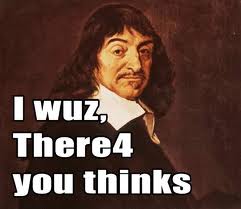
Though this be true, I must nevertheless here
consider that I am Sophy, and that, consequently I am in the habit of ingesting
excessive amounts of caffeine, sleeping, and representing to myself in dreams
those same things, or even sometimes others less probable, which a humorous
person keeps in mind in the event one occurs – this way, you’re poised to
laugh. How many times have I dreamt that I was laughing and dancing with all my
friends, who were all dressed rather extravagantly, when I was instead lying in
bed floating on luxurious Egyptian sheets? At present moment, however, I certainly look
funny sitting here with this laptop draped across my lap, boots up on the bed,
tea by my side, with eyes wide awake; I type with purpose (or lack thereof); I
extend my fingers consciously and with express purpose; and I perceive it; the
occurrences in sleep are not so distinct as all of this. Still I cannot forget
that, at other times I have been deceived in sleep by similar ridiculous
illusions; and, attentively considering those cases, I perceive so clearly that
there exist no certain marks by which the state of laughing can ever be distinguished
sleep, that I feel greatly entertained and astonished; and in amazement I
almost persuade myself that I am now dreaming that I am laughing.


.jpg)