Showing posts with label Quantum Mechanics. Show all posts

Thursday, June 12, 2014

26 Dimensions of the English Language


In string theory, all matter is envisioned as tiny vibrating strings, orders of magnitude smaller than the teeniest tiniest particle we can observe today. These strings are so tiny that scientists who work on the theory haven't yet found a way to experimentally observe a string, only consequences of the strings interacting. 


In quantum mechanics, the forces - electromagnetics, the strong nuclear force, and the weak nuclear force - work only because of bosons, special types of particles that bounce around and make them work. These bosons are also created by vibrating strings, so all matter and its various interactions are described as being different types of vibrating strings. 

This realization led to a prediction that caused a number of scientists to abandon the theory all together. String theory ONLY WORKS if you set up equations so that the universe has a total of 26 dimensions.

BIG BANG THEORY
"Pilot" episode

Leonard:  At least I didn't have to invent 26 dimensions just to make the math come out.

Sheldon: I didn't have to invent them. They're there.

Leonard:  In what universe? 

Sheldon:  In all of them. That's the point. 


The equations of string theory necessitate twenty-six dimensions. Beyond our known space-time dimensions: up/down, left/right, front/back, and a dimension representing our movement through time, what properties would these other dimensions represent? 

Let's take a look at the English alphabet with its 26 letters for a possible answer.


Used with units of measure, the letter "A" represents each string as a unit of measurement. 


As with plan B, "B" represents an alternative string. 


The third fixed constant or known constant represents the constant of a given string. 


The diameter of a string.


The transfer or information exchange between strings. 


The frequency of a string.


The unit of gravity equal to the force exerted on it by a given string.


The fundamental constant of a string. 


An imaginary string. 


The force of one string when it moves position. 


The base temperature of a string.


The length of a string.


The mass of a string.

An unspecified string.


Used when strings combine forms.


The probability that a string will exist.


Denoting the hypothetical source of strings.


That which gives position or direction to a string.


The distance between strings.


A hypothetical entity with a mass 360,000 times that of a string.


Denoting the change of a string.


Opposing strings.


Corresponding to a one unit difference between strings.


Denoting the principal or horizontal axis in a system of strings.


Denoting the action or result of a string.


Used in repeated form to represent the sound of buzzing strings
zzzzzz, zzzzzz


This brings us to the heart of string theory, and all of theoretical science: how much trust should be put in the equations, absent experimental confirmation? Based on the 26 Dimensions of the English language, there is no real reason to put faith in any theory, especially if it requires a boson to work.


This post was created to explain that string theory must have a system: gravity, alphabet, or otherwise, to make it work. That doesn't make string theory wrong, it just makes it really complex and super hypothetical. But it is fun to think about ... 


Tuesday, May 6, 2014

What Moves Forward


If I understand quantum mechanics correctly - which, of course, I'm sure I do not - quantum particles, the stuff under all the turtles, is essentially the "stuff" from which we all are fashioned. If these particles cannot be destroyed, then, theoretically, the particles that belong to each and every one of us, will simply transition from particles held in our current material combination (i.e., you or me) into free floating or wave surfing particles when we're done with this particular material configuration... forever rejuvenating in a Dr. Who'vian like multiverse. 

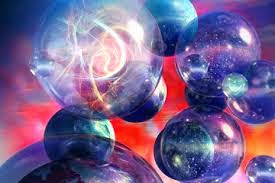
The Everett many-worlds interpretation, formulated in 1956, holds that all the possibilities described by quantum theory simultaneously occur in a "multiverse" composed of mostly independent parallel universes.


The crucial question here is "Why?" While the physics of rejuvenation is not entirely difficult to wrap one's mind around, there still remains an unanswered metaphysical question: "Why something and not nothing?" and, as it is the subject of this post: "What moves forward?"

For most people, it would appear that this rejuvenation process destroys the majority of the particles associated with self-identity, short- and long-term memory, and conscious awareness. However, what about those individuals whose particles align in a fashion from which spontaneous Dr. Who'vian like recollection occurs? 

"Doctor?" To which he haughtily replies: "You were expecting someone else?" 


This article is not being written for quantum theorists ... they are far too busy reading science articles. This article is for those individuals who surf Internet fodder to entertain themselves whilst waiting in a dentist office, waiting for their wives to finally emerge from the bedroom in time for date night, or just plain waiting or not having anything better to do with their time but surf around the Internet for non-bizarre tales, like this one. 

Enough of that ... let's move on. 

For me, life itself is funny. The fact that we exist is funny. The whole wikepedian thing is funny. And all that funniness causes me to ask questions, the kind of questions we philosophers recognize as philosophical. 

With that being said, and assuming your brain hasn't yet been seized by a Pop-Up ad, upon which you clicked and are now shopping on Amazon, let's continue. Let's jump off Max's planck and hypothesize just exactly where particles go.

If we are held in a mostly closed multiverse (with a tiny leak), then hypothetically, these particles don't go far, at least not initially. They would have to travel from one space to another space (or at least that's what my linear brain tells me). But let's expand our mindset and presume that these particles could simultaneously appear, disappear, and reappear anywhere or nowhere, depending on the theory you embrace, they might be inclined to do one of the following: 
  1. Gather enough needed particles to rejuvenate into the same but differently configured material being
  2. Find themselves in a bad neighborhood of the multiverse and quickly need to rejuvenate, suddenly finding themselves rejuvenating into a stop sign or alarm clock. 
  3. Travel around the multiverse until they have gathered enough of their old particle buddies and rejuvenate again in an amalgam-like, previously constructed material configuration fashion.


Wherever, whenever our quantum particles travel, they are sure to be encoded with every memory, thought, and/or sensation we have ever experienced. Like Dr. Who, each material manifestation or "new" incarnation might come with its own set of physiological problems, such as the Fifth Doctor's gas allergy ("The Caves of Androzani"). 

The question of who or what moves forward was initially a joke that is now occupying my philosophical brain. For some time I was of the opinion that there was enough "stuff" in the material multiverse(s) that we didn't need to recycle our component parts, but for the last couple of years I have begun rethinking that idea. 

Examining Eastern Mythology, Western Philosophy, Quantum Mechanics, and a splattering of other lesser known metaphysical theories, I have come to same conclusion that I have come to time and time again: that we cannot know. 

That's when things get funny. Our serious attitudes, our knowing, our believing, our professing, our arguing over who's right and who's wrong, over which direction is up and which direction is down, over how things should or should not be... this is the fodder for good jokes, but not necessarily for good philosophizing, the kind that allows one to question without being attached to the answers. "The questions themselves are the answers we seek," I wrote in a poem twenty-some-odd years ago. 

With nothing more to add on this subject this morning, here's some cool Dr. Who pics for your brain: the amalgam that it is