
Wednesday, May 27, 2015


Truth and Beauty
The books that help you most are those which make you think the most. The hardest way of learning is that of easy reading; but a great book that comes from a great thinker is a ship of thought, deep freighted with truth and beauty.
~Pablo Neruda

Lost Ship
Truth and beauty are of vital significance (like pain and pleasure) and are awakened by the rhythms that arouse our receptive sensibility and prepare it to react in a special, intended way. Once aroused our entire experiential system is activated.
The natural emotions do not reverberate alone; they enter, sometimes softly, sometimes vehemently into the network of our sentiments, which activate our imagination, our ideas, and our values. Sometimes they arouse us to levels barely perceptible, even to our keen radar; sometimes they evoke within us the unfolding of an entire work of foreboding art.

Dwa światy
Truth and beauty, pleasure and pain, are filtered through our most intimate of personal tastes: inclinations, tendencies, imaginings, ideals, and moral sentiments. They flow through us, but their imprint upon our biological mechanism is coarse, and leaves behind a vital mesh intimately woven between the flesh and our existence of the world.
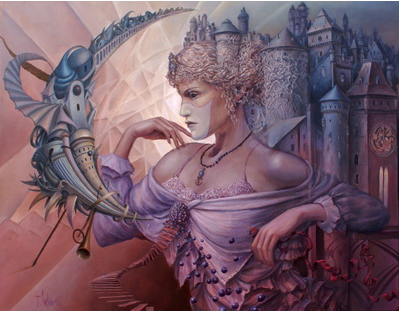
Zła Królowa
One might think Truth and Beauty stand apart from each other, but it is precisely where the focal points of their joint association come together that they expand outward. Standing on the precipice of eternity, on the furthermost side of our essence's abyss, hover over a ridge looking out over the horizon intuiting only that distance that separates one from one's own thoughts ... we see
Truth often feels like life's most crudest of realisms. Alone it depicts life as a mere factual reality, but with Beauty's mirror, truth's inner core is revealed, and reality expands, transforming in its wake those filters that encompass our multiple spheres of reality into a moving sentiment of spirit. The spirit in harmony with its truth respects established patterns and inner laws of reality proper to drive forth the mechanism toward acquiring life.

Księżycowe Miasto
Lightly suspended, hanging from the lyrical cord of reason, is a quiet essence apart from the civilization of thoughts we carry forth through this sea of existence. It is precisely herein where we encounter those inner truths that can be harmoniously expressed through all sensible encounters, either expressed or sent our way by others.
Protecting this silent sound in the wake of a tempest modulates and transforms the spectrum of receptive sensibilities toward innermost acceptance and resignation, joy over the order of things, and reconciliation. Here we are creative with our emotions, feelings and sentiments. Here we reach back toward the highest elations of metaphysical experience where we might soothe the pain-redeeming process and set it free, back on the path toward those lyrical chords that resound throughout reality; the ones most natural and most lovely amid Eternity's selections are the ones I choose to see.

Bez tytułu
Friday, May 22, 2015
Benevolent Weapons of Humorous Destruction

Erce, erce, erce eorþan modor, mother of Earth
Æcerbot (Old English "Field-Remedy") is a delightful Anglo-Saxon charm (full-day ritual) recorded in the 11th century. Its purpose was to remedy fields with poor yields. Similar to the Latin sanctus, sanctus, sanctus, derived from eorcnan "true, genuine; holy", or from Eorce (fertility goddess, addressed as "Mother of Earth"), the æcerbot was a partially Christianized prayer and day-long ritual that began at night, as it was then customary to take sods from the field to mass before returning them to the field prior to nightfall, each with a small cross planted in it. The sod was then Christianized. Chants such as Erce, erce, erce eorþan modor, mother of Earth were sung to heal the earth while the plough was anointed with oil, paste, frankincense, salt and fennel.

Dating back to the Bronze Age, tribes were united by their veneration of the goddess, and with deep reverence, attended her needs, which in some cultures included ritual sacrifice. Those individuals not of the Christian faith were referred to as "heathens" but in reality all religions put people to death for reasons associated with their beliefs. Ritual sacrifice is indeed heathen-like, but it is not dissimilar to the punishments (or modern day judgments) inflicted upon millions of people by other so-called benevolent groups. Throughout history every religious group has defended atrocious acts against its fellow world citizens in the name of the mother goddess or some other supernatural deity. The moment one attempts to defend unjust actions (or judgments) in the name of a principle or deity or any such belief or thing other than simply doing what is just for all concerned is where error in judgment becomes transparent. It is the same in humor. The moment one tries to cover up judgment with humor the error in thinking becomes transparent. In this sense, humor, like the sword, is being utilized as a weapon; only in this instance it is a passive-aggressive weapon. A weapon in the name of humor, god, the mother goddess, or any such deity is still a weapon if used to inflict distress upon another.

Josephine Wall
The terms 'mother goddess' and 'fertility goddess' are problematic since the functions of many goddesses overlap, but I refer only to the generic term 'mother goddess' as a matter of convenience.
In the third and second millennium BCE, the mother goddess was in high standing within the divine hierarchy of gods. She is mentioned together with the highest gods of the Mesopotamian pantheon, An, Enlil, and Enki.
Goddesses of war and healing gained favor come the second millennium BCE, though mother goddess retained her role as creator of humankind, however accidental that creation might have been (Nintur creating humankind by mixing clay with the blood of a slain god [Lambert and Millard 1969: 57-61],).
Nothing is known about the mother goddess' divine parentage. An, Enlil, Enki, and Sulpae are sometimes associated as being her husbands (Krebernik 1993-98a: 507-8). Because mother goddess appears under so many different names and with so many different attributes, she has been referenced as justification for a myriad of beliefs and actions taken in her name.
In reality no belief, action, or joke makes anything transparent other than the individual's own belief system or desires. The "funny" thing about exploring humor is that what might at first be interpreted as humorous often leads to tales of greater importance than an otherwise unsuspecting joke might lead someone to interpret, at least on the surface.
Humor is one of those entertaining lenses with which to view the world and or examine our species' historical productions. It is not always an accurate lens, but it lightens interpretations so that thoughts might be considered rather than felt on an emotional level. The challenge is allowing for both humor and reality to be simultaneously present.
Humorous discourse enables us to make light of those otherwise heavier thoughts and ideas by making fun of information that might otherwise cause us emotional distress. Remembering the difference between the two (humor and reality) is what we call: good humor.


Sunday, May 17, 2015
Quantum Teleportation
A new loosely held hypothesis based on gravitational
forces might just offer the secret to making
quantum teleportation devices a reality

In general, galaxies grow in size by merging with other galaxies to become increasingly larger. Over time gravitational forces bring them together despite the expansion of the universe. El Gordo, the biggest known cluster of galaxies, for example, is the result of a collision between two large clusters. During the collision process gas is compressed within each cluster to high temperatures. Scientists estimate the relative speed of the collision by measuring the comet shaped gas cloud with two long tails stretching between the dense cores of the two clusters of galaxies. The estimated distance is ~2200km/sec.), which puts it at the limit of what is allowed by current theory for dark matter, but that is a discussion for another day.
If we were to extract one nugget of thought from gravitational forces: gas; and insert it into our loosely held quantum teleportation hypothesis, we might consider the following scenario:

Imagine a device that compresses the particles between spaces, colliding them if you will, so that distinct spaces become closer or fold in on themselves.

Conceptually we're talking about folding a sheet of paper (space) in half so that one end touches the other. If one end of my sheet is Paris and the other end Mexico City, folding the paper in half would bring these two points in the universe much closer together. The trip between the two would then be near instantaneous. By compressing the particles, quantum teleportation or the bending of spacetime is conceivable. Essentially when we fly from one location to another, we are flying through particles. Compress them and bring them closer together, and voilá, we now have the geometry upon which to construct our teleporter machine.

If you imagine space or the air as being filled with all sorts of particles, coming in and out of existence, changing shape, colliding, etc. then "air" is not vacant; on the contrary, it is crowded and busy with lots of particle traffic.
Transport phenomena concerns the exchange of mass, energy, and momentum between observed and studied systems. Simply put, basic conservation laws come into play. The fundamental analyses in all three subfields: heat, momentum, and mass transport, are the phenomena that lead to transport, the sum of their contributions equalling zero.
Given that transport phenomena encompass all aspects of physical change in the universe, we can consider the possibility of quantum teleportation as a phenomena in relationship to a physical system.
Usually we consider transportation like this ...
or like this ...
Whereas in quantum teleportation we're essentially talking about ...
and this ...
Irregardless of how you or I consider momentum transport, systems move toward one another by nature of their arrangement. Compressing the particles that separate one space from another essentially involves our destroying our sense of "material" identity via heat conduction (energy transfer), fluid flow (momentum transfer), molecular diffusion (mass transfer), radiation and electric charge (such as those used in semiconductors), stepping into a quantum teleportation machine, and bending space or otherwise compressing the particles that separate California from Paris.

For Readers who grew up watching Star Trek (the original or Next Generation), you know that the Away Team was converted into energy waves and then reconverted into solid objects, like how a telephone converts our voices into electromagnetic waves till reconverting them into sounds.
With the advent of a molecular scanner, we could decode our entire quantum signature (or at least our material signature) and hypothetically convert that into electromagnetic waves, then rebuild or reconvert that data into our physical body, intact with all its memories and corresponding idiosyncrasies (such writing in a blog) and POOF! ... magically appear someplace else.
Metaphysically speaking the possibilities of quantum teleportation are not limited to this planet or even to this galaxy. Engaging our hyperspace drive, the possibility of inter-dimensional transportation or jumping galaxies by compressing the space (particles) that separate galaxies from one another is conceivable. And while we're at it, if we're not limiting our transportation theory to linear behavior, perhaps someday we'll be able to travel in nonliner directions, i.e., time travel ... though we might have to be willing to hop inside a black hole to make that happen.

Teleporting to Paris for a private art showing, thereafter to London for dinner, and then back to Mexico in time to tuck our kids in bed before they go to sleep really depends on the state of the science, the state of the technology, and if we are willing to hop inside a quantum teleportation device. I can't say I'd jump to go first, but I'd definitely be an early adopter if given the opportunity. Until then I'll have to contend myself with traveling the old fashioned way ...

Friday, May 8, 2015


Monday, May 4, 2015
Two Ways of Seeing a Park

I still keep in mind all the wonderful sunsets I watched while lying on the grass constructing daisy chains or pathways for the park's insects to traverse. This is when the park was new to me. A broad expanse of green grass was turned into a loudly populated playground for all of the neighborhood kids our town's new construction attracted; toward the side of the park the shine from the metal frame separating the tennis courts from their surroundings still burned my eyes; three evenly placed benches were no longer forts under which my friends and I could invisibly hide from unsuspecting grown-ups, they were now lowly benches upon which tired, overworked parents rested while their children played unsuspecting and unaware of the changes in perception that will eventually mark the end of their childhood memories, too.
New trees had been planted, but I looked upon them with solace, from the perspective of an older oak who had been there longer. These trees didn't yet know the park as I did, they had yet to discover its many nuances, its breaks in cement and its rough rocks. These kids like these trees didn't know the best path to cross the bed of rocks separating the park from the edge of the school ground and the back of the neighborhood community. Only we who played here from the time the park was built knew the best way to cross those rocks without slipping and scraping your leg or knee in the process. Whenever someone's frisbee flies out of bounds, it is only the most daring and knowledgeable who retrieve it. There were also graceful curves along the pathway, which I knew well. These curves reflected the marvels of architecture and city planning that I never before pondered as a child. Before they were cement streets upon which we drew dotted lines with outdoor chalk so that we could race our bikes.
I stood like one arrested in thought. I drank it in, in a speechless appreciative rapture. The park was new to me, and I had never seen anything like this in Paris. But as I have said, a day came when I began to cease from enjoying the park. Instead I noted its glories and many charms which the moon and the sun and the twilight wrought upon it; another day came when I ceased altogether to notice that, too. Then, if that sunset scene had been repeated, I should have looked upon it without rapture, without fond memories, and should have commented upon it, inwardly, in this fashion: "This sun means that we are going to have wind tomorrow; that overgrown bush means that the gardeners will trim it come Tuesday; that break in the cement is not from an underground colony of exoskeleton warriors breaking free into the world, but rather something the city should replace, and soon! And if they don't do so, somebody could get hurt; the signs clearly state that no dogs are allowed in this park, and look over yonder, people playing fetch with their dogs in the tennis courts; such blatant disregard for the rules that are there to maximize the entire community's enjoyment of this park; and how is anybody supposed to enjoy the park when it is so crowded and overgrown with runamuck lavender bushes?"
No, the enchantment and the thrill were all gone from the park. All the value of any feature it had for me now was the amount of usefulness it could furnish for the community at large. Since those days, I have pitied analysts from my heart. What do the marvels of technology mean to a researcher but a "critique" that ripples above the next upgrade? Are not the world's epiphanies and triumphant inventions sown thick with what are to him the signs and symbols of outdated information? Does he ever see their inventiveness at all, or doesn't he simply view ingenuity professionally, and comment upon it as a condition of fact and judgment rather than artfulness and virtuosity? And doesn't he sometimes wonder whether he has gained most or lost most by learning his trade?
Inspired by Mark Twain's 1883 Two Ways of Seeing a River, from his autobiographical Life on the Mississippi, in which he considers what may be lost as well as gained through knowledge and experience.
Sunday, May 3, 2015
Being and Becoming

Peter Sellers
How do we reconcile being and becoming? The idea of unchangeable Being (of Parmenides) with eternal Becoming (of Heraclitus) seems in and of itself paradoxical, a sharp contrast between two views commonly associated as being manifest in our daily lives. When you try to separate these concepts, you get things like atoms. The mixture and separation of Being manifest in certain invariable substances led to the concept of indivisible units of matter, when Leucippus and Democritus helped us understand when they drew a clear line between spirit and matter, picturing matter as being made of several 'basic building blocks'.

But how boring is our reduction of the stuff of the universe. Essentially philosopher-scientists envisioned the world as being composed of purely passive and intrinsically dull particles moving in a void. I'm wondering how many of our explanations of the universe reflect the scientist making the discovery.
Let's face it, the image we have of the cosmos has become an essential way of thinking about the cosmos. How do we break free of the seemingly paradoxical dualism between mind and matter, between body and soul, without eliminating the essence of those forces that causes things to move in the first place?

(Image: Hulton Deutsch Collection/Corbis)
Essentially we're trying to systematize and organize the concept of perfection; imagining the entirety of all existence and existing from a finite space: the brain. For example, if I imagine myself to be nothing more than my processing bioenergetic mechanism, I leave the thought feeling a bit empty, devoid of that eternal hope that purses through my being telling me that I am more. If I am 'more', I am now separate from my processing bioenergetic mechanism - enter duality. If I 'AM' ... AND ... meaning, if I am, if I exist, AND I exist in a processing bioenergetic mechanism it is because I am passing through this geometrical space, its methods and principles, increasing and decreasing in particles in relation to nearby fields which act and are acted upon by nature of the properties existence creates.
In other words, I am and I incorporate ALL the spaces I inhabit, INCLUDING my present processing bioenergetic mechanism from which I currently perceive my own existence. If the cosmos exists and is present with Itself, It sees itself from within every motif, from each distinctive feature or dominant idea in the composition of the cosmos.
In this sense Being and Becoming are one and the same. We need not reduce ourselves to the extreme formations of spirit/matter duality. There may exist multiple realms, and the view from each may differ significantly, but we need not construct mechanics to separate them just because they feel separate or appear to be so. We need not fashion monarchical gods to rule the world from above by imposing divine law upon us. By nature of a god's existence It too would be held within the world It inhabits, and thus subject to the same many changes of form all existence experiences. The concept of separation thus becomes ludicrous.
The philosophy of Descartes was important for the development of classical physics, but it also led Western thinkers into a space where we now identify themselves as isolated egos existing 'inside' our bodies, as minds instead of as a whole organism with multiple compartments from which to experience existence.
The notion of becoming comes into play when we perceive from new or seemingly distinct spaces not before considered. Take for instance shifting our awareness insomuch as is possible to our left foot. It is now from our left foot that we perceive the world. We think about this foot, we wish to pamper it, to make its world softer and more pleasant. We surround our rooms with pillows so that our steps might be lighter. We paint and decorate our foot. We build devices so that our left foot might not have to share in the load placed upon it when we are in a state of locomotion. We are our left foot. We create altars to it.

The Golden Foot, 2012
Tribute to footballer Lionel Messi
Ginza Tanaka
Sold for $5,250,000
The Cartesian division and the mechanistic world view have, living up to the division that initially created them, been both beneficial and detrimental at the same time. It is for this reason that we have the subjects physics and technology, which originated in the Cartesian split and in the mechanistic worldview, and which notably came into being because of such views.
It makes conceptual sense that when looking for keys to longevity, of the systems we occupy and create, we would look to integration theories, to ideas that express unity between these seemingly distinct views.
Eastern philosophy integrates and connects all aspects or manifestations of reality, whereas the Western mindset tends to divide and separate things, measuring and categorizing mentally. In Buddhist philosophy this tendency is equated with avidya, or ignorance; essentially, a disturbed mind in need of being overcome:
When the mind is distrubed, the multiplicity of things is produced, but when the mind is quieted, the multiplicity of things disappears. [1]

A boy blowing on an ember to light a candle, c. 1520
El Greco
Private Collection
In the Eastern view the division of existence into separate objects is not fundamental. All objects have a fluid and ever-changing character, which when considered upon leads to the conclusion that eventually you will become me, I will become you, and we will all, at least once, become the very candle we blow out.

References:
[1] Ashvaghosha, The Awakening of Faith, p. 78
Subscribe to:
Posts (Atom)