Friday, October 26, 2012

The Twilight Halloween Zone


The Twilight Halloween Zone is a mixture of self-referential drama, psychological thriller, fantasy, science fiction, suspense, and candy corn, often concluding with candied apples or an unexpected carmel twist.


THE MARSHMALLOW ELEMENT


Many years after the Oklahoma City bombing, a man named Jeep En Snort visits a past lives therapist, Dr. Liege Slip. Snort tells of a recurring dream where he tries to warn people about the "sneak attack" on 9/11, but in his dream the warnings are disregarded. Dr. Slip insists that time travel is impossible given the nature of temporal paradoxes. 

Snort finally reveals that he was actually in New York on September 11, 2001, thanks to a time machine he built - a time machine powered by marshmallows. While on the couch, Snort falls asleep once again and finds himself on one of the planes flying overhead. He loses his life in the crash. 


In Dr. Slip's office, the couch Snort was lying on is now empty. Dr. Slip goes to a bar where he finds Snort's picture on the wall. The bartender tells him that Snort had tended there, but died during the attacks on 9/11. 


The Keys to Happiness


In computing, the main keys to happiness are the colon and right parenthesis ASCII characters. 

:)

Following the decline of punch cards and paper tape, lighthearted interaction via teleprinter-style keyboards became the main input device for computers. 

Today, keyboards are used for typing text, and creating funny symbols and characters that resemble a myriad of smiley faces or expressions that help emphasize meaning. 


These computing keys, when combined, evoke within us the sensation of happiness... so much so that smiley faces are now appearing as tangible objects outside the digital world of the computer. 


Mental Break


DIRECTIONS

Look at Animated Photo (Above)

Feel better?

YES or NO

If Yes, Congratulations! 
You know how to relax.

If No, Try again. 
You're obviously too stressed out.

HISTORY OF MENTAL BREAKS


Mental Break is the general term for a period of time in which your mind doesn't want to do anything but be entertained by mindless moving images. In politics, a mental break is initiated by a motion to "hide from the media" in order to "chill out" and "take the edge off."

Mental breaks were invented by our exhausted predecessors, who wanted nothing more than to forget about their hunting, gathering, and cave drawing duties in order to have some active physical playtime and time to grunt back and forth about the weather.


Funny Star Wars ID3 Tags


Funny Star Wars ID3 Tags are humorous metadata containers used in conjunction with the MP3 audio file format. They allow information such as jokes, one-liners, movie quotes, and other information about the file to be stored in the file itself.


There are two unrelated versions of ID3: ID3v1 and ID3v2.ifUr. While many consider the ID3v3.aintgotnomoney funny, advocates for the new IDR2D2 Droid tag believe that there should be an Old Republic-like standard involved in the creation of Funny Star Wars ID3 Tags.

"Notably, this would necessitate the creation of an organization to provide formal approval status, but right now our de facto funnies are not up to the standards of the Fan Art Counsel." (SWTOR ID3 Tag Representative.)


Sample IDR2D2 Droid Tag

$00     Beep. Beep.
$01     C3P0, help. Beep.
$02     Beep. Boop. Beep.
$03     Chirp. Beep. Gulp.
$04     Beep. Cover me, too. We're goin in.
$05     Holy Beep!


Thursday, October 25, 2012

Top 10 Work Excuses

Humor helps to reduce stress, but isn't always welcome in the workplace. If you work in a stuffy environment and feel as though you need to do something to preserve your own sanity, empower yourself and with these translatable work excuses. You'll increase productivity, employee morale, be labeled as "dynamic" and "forward thinking" by your boss, and have a lot of fun in the process!


TOP 10 WORK EXCUSES
(Oh, the excuses you'll get...)


  1. "Humor" is a perfect excuse to give when you want to take a risk. 
    • EXPLANATION:  I read a study online regarding the relationship between good humor and employee retention, and was exploring what makes our employees laugh in order to decrease employee turnover. Fred, from accounting, has an excellent sense of humor. Naturally, I recognized that I should start with him, first. 
    • REALITY:  Fred and I were laughing about something that happened last night when we left the seminar, went out for drinks, and ended up with Kamikaze Kat tattoos. 
  2. It was not a mistake - it was a joke. 
    • EXPLANATION:  I purposely included the typos in our annual report for humorous effect. Studies indicate that 63% of the population enjoys reading misspellings. Next quarter, we plan to include pictures of cats and kittens for the full-effect. 
    • REALITY:  I'm lazy and forgot to proofread my work. Besides, if our investors didn't have something asinine to complain about, they might end up paying more attention to the financials; then they'd notice that we're overpaying ourselves despite the fact that the stock is underperforming.
  3. Jump right in when you don't want to wait for instructions.
    • EXPLANATION:  It is always prudent to test our legal counsel's advice to ensure that it adequately supports our initiatives. 
    • REALITY:   I didn't want to read the disclaimer, it's too long. Besides, nobody ever really reads those things, do they?
  4. Say things the way you see them. 
    • EXPLANATION:  I felt it was important to point out the mistakes of senior management at the sales retreat in order to boost employee morale. I read a study where humanizing management actually empowers employees to work together as a team, getting more things done in the process. Besides, the team believes we should spend our energy on solutions, not on emotions.
    • REALITY:  Since we're not getting our quarterly bonus, we felt we at least deserved a good laugh. 
  5. Go for it.
    • EXPLANATION:  Quality is the trademark of this company. The cornerstone of our brand. We contracted the teenage hackers down the block from my kids' school because they know the ins and outs of our technology better than our own engineers. By the way, I'm on vacation next week, but I'll have my Blackberry with me. I'm sure you recall my mentioning it last month.
    • REALITY:  We thought it would be funny to include hacking software in our products. We had no idea they'd end up hacking into our company database...I'm sure the money will reappear. By the way, I'm looking forward to our trip to the Bahamas.
  6. Break things. 
    • EXPLANATION:   Destruction is the first step in the creative process. We wanted to test the durability of our product in order to make improvements prior to the next production run.
    • REALITY:  We were filming a TOTAL DESTRUCTION video for YouTube. We thought it was hilarious. It got over 1,000,000 hits last week! We're hoping to quit our jobs here and become Internet Superstars! Wait 'till you see the video we're working on now...
  7. Take chances. 
    • EXPLANATION:   Focusing on opportunities, not problems, is how we attract new customers. It also helps us retain loyal customers. Our department has seen an increase in employee morale and an uptick in productivity during the week when we leave the office two hours early on Friday afternoons.
    • REALITY:  None of us feel like working on Friday. We wanted to beat the rush hour traffic. We figured you wouldn't notice. 
  8. Experiment. 
    • EXPLANATION:   Our experiments have allowed us to discover what doesn't work, which we have now identified as an integral component for our next update. This will surely improve our online ratings.
    • REALITY:  We just wanted to see what would happen. 
  9. Try easier, not harder.
    • EXPLANATION:   Sitting around the office in lounge chairs might look like we're goofing off, but in reality, we're allowing the creative process to flow from within. Each employee has reported a surge of creativity afterwards, which, I'm happy to report, has resulted in an 8% increase in productivity this week alone.
    • REALITY:  We are in the middle of our beer pingpong tournament and don't feel like working.
  10. Have fun!
    • EXPLANATION:   Studies indicate that 84% of senior executives and human resource directors think that employees with a sense of humor are more effective than those with little or no sense of humor. Putting soap bubbles in the water cooler was an attempt to ascertain which employees have a sense of humor as opposed to those who do not. We will be sending you a video memo on the subject.
    • REALITY:  We are still laughing our asses off! 


Wednesday, October 24, 2012

Sophy's Laser Disco Ignition Facility


Sophy's Laser Disco Ignition Facility (SLDIF) is the world's funniest laser disco producing facility. SLDIF's 42 intense laser beams can deliver to a target more than half way across the room, which is way further than the energy of any previous laser system. SLDIF became operational last night after popping into a laser disco club in Paris and the morning afterwards is now capable of directing nearly four joules of ultraviolet laser energy in billionth-of-a-second pulses to the target on the other side of the room. Some friends from the club witnessed this phenomenon early this morning and said that it felt like "someone had triggered a photobiological response in their tissues" and that within an hour or so they felt really great as if someone had healed them from the inside out.

HOW DOES IT WORK?

There's all sorts of cool and interesting ways to build a laser, few of which actually have the capacity to destroy a planet. Basically, a laser squeezes energy into a defined visible wavelength (i.e., red or blue), concentrating this energy into a low-divergence beam. 


The 3 primary parts of a laser are an initial energy source (pump source) such as a coolness factor, a medium that, when excited, spits out photons of rainbow colored defined wavelength (gain medium), and a way to hijack the power of a small city in order to power these photons (optical resonator). 


Similar to the helium-neon laser, Sophy's laser traps energy between two mirrors, one that reflects all the light and one that reflects most of the light. 

So....

the energy bounces back and forth in the gas, tickling the photons, before finally laughing out loud as it leaks out through the semi-transparent mirror and totally annihilates anything in its path (or finding narley ways to liven up a disco). 


Tuesday, October 23, 2012

Making Sense of Humor

Researchers of the subject (or phenomenon of) humor generally have a wealth of ideas and questions about what makes people laugh, as well as innovative ideas and exploratory skills for uncovering examples that verify their own theories on the subject. Reading and analyzing these papers (books, studies, transcripts) is both exciting and daunting. Aiming to research humor in a way that is personally gratifying, socially responsible, and yet, authentic, is a challenge I face every time I write a post.


In order to make sense of any subject, it would seem that we first have to make sense of ourselves. Who we are, the things in which we believe, the morals we wish to express, and the integrity in which we wish to express them. It is from this starting point that we begin to look outside ourselves for continuity or discontinuity. It is from here that we begin to identify, question, and later label experiences and observations in a way that communicates to others what we have uncovered in the hopes of enlightening others. 


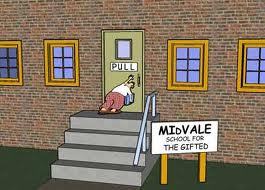
Take for example going to a conference for gifted children: The speaker asks the audience how many of the parents are they themselves gifted, parents often times look around the room, some raise their hands while others look conflicted and seem reluctant to admit to gifted traits, behaviors, and issues that they share with their children, and therefore choose not raise their hands (even if they do consider themselves as gifted).  The challenge here is that in order to raise a gifted child in a way that honors their "giftedness" a parent first has to resolve the issues of giftedness within themselves. 

(Is the child misunderstanding the sign (i.e., not gifted) or is the child testing the sign (i.e., gifted/curious)? 


In the same respect, researching and writing on the subject of humor without first recognizing it in ourselves results in biased, often times, confused or conflicted theories about how to open the door to humor in a way that inspires new ideas that lead to uncovering hidden knowledge within ourselves and others. 

In order to make sense of humor, we have to recognize it within ourselves and be willing to experiment with the door, push when it says pull, and give it a little kick when it says knock lightly. Not in a way that is offensive to others (that would be socially irresponsible), but in a way that we can authentically explore aspects of humor we wish to examine for ourselves. 


If a researcher states that humor is a mask for aggression, it is more likely that the researcher utilizes humor as a mask for aggression. If a researcher states that humor masks violations we wish to resolve, it is more likely that the researcher is searching for when their own violations would become benign. The point is, we find what we seek. 


So, what does my humor say about me? 

First, I seldom feel comfortable labeling anything or anyone given our shared ignorance of the nature of existence. While many people do profess to hold the secrets to life, it is my belief that they hold the secrets to "contentment" rather than the nature of existence. 

For this reason, I am reluctant to make definitive claims. Instead, I prefer a specific approach. My approach to humor it to seek out humor that does not cause further discomfort or ill-content. My goal is to share humor that elevates moods, lightens burdens, and brings people together in a world that can otherwise feel overwhelming and lonely. I'd rather risk being mildly funny rather than cutting edge if it means violating my own principles. 


Take for example the following comic. 


I find it funny, but not for the reasons some might suspect. 

First, I find the idea of artificial intelligence intriguing, thus the idea of a computer telling it's own jokes makes me laugh. 

Next, evolution, per my understanding, means change over time. Since I notice change in myself and others, I believe change exists. When others discount evolution, making the theory about creation or not creation, they are committing a logical fallacy. The theory is not about whether or not there is a God, but whether or not we as a species evolved from another state of existence (i.e., single-celled organism).  Evolution doesn't suggest "why", it simply demonstrates "how." While this concept may be in contrast to creation myths, the theory itself is not about religion. To reject it simply because it is perceived as a violation of one's belief in "creation" is illogical, and therefore recognized as a problem of logic, which makes me laugh (not at the person's who hold this belief, but in the complexities of logic in an environment or system that is not yet understood or defined). 

Since I believe humor has more to do with a shift in perception, the problem of creation vs. evolution doesn't cause me to laugh at others, it simply causes me to laugh at how we all, at one time or another, take one subject and then make it out to be something else. 

Finally, contaminating our planet affects the temperature (as well as many other factors) on the planet. Naturally, this change in temperature results in ice caps melting. The challenges inherent in this occurrence are just now being explored. Only time will tell what the full potential of how that will affect us all.


As a researcher, my work might not ever be as cutting edge as it could be were I to share everything I uncover about what makes people laugh, but it does represent an earnest desire to explore humor in a way that feels good for myself without recklessly causing others discomfort. Naturally, that will make my humor biased toward what others have labeled "A Modern Twist of Reader's Digest's Good Humor" or "family oriented" humor.